
AIPJ 2025 Year in Review
As we head into the end of 2025 and a winter break, we’re grateful to look back on an intense, productive, and deeply generative first 9 months of work. We publicly launched the AI + Planetary Justice Alliance (AIPJ) in April 2025, with a mission to trace the ecological, social, and political impacts of artificial intelligence across its full lifecycle — from material extraction to disposal, and from infrastructures to communities.
Here’s a reflection on what we’ve built, published, engaged with, and contributed to in the past nine months.
Published Resources
The AI Supply Chain Impact Framework
We released a living framework to assess the environmental, social, and political impacts of AI systems across their entire lifecycle—from raw material extraction, through manufacturing, model training, and deployment, to disposal. We aim to make visible the extractive and exploitative dimensions of AI production that are often hidden in mainstream responsible AI discourse.
This tool is both a mapping and accountability instrument. It is built to help researchers, policymakers, civil society, and affected communities interrogate the AI industry’s practices, demand accountability, and push for systemic change. By identifying what we know and what we do not know—and by highlighting key data and information gaps—the framework challenges us to ask the critical questions: What materials go into AI systems, and at what cost? Who extracts, processes, and assembles AI hardware, and under what conditions? How do these processes impact local communities and ecosystems? And what happens to AI infrastructure when it is no longer in use?
The Raw Materials for AI Zine
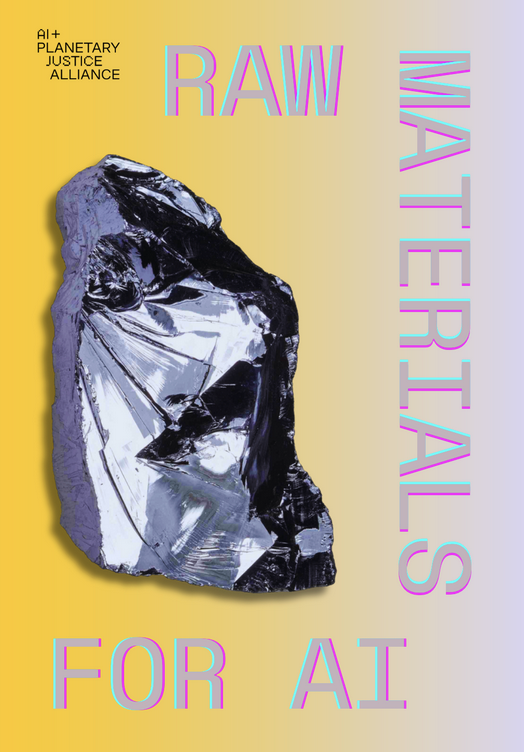
As part of our Below the Algorithm project, we published a visual, accessible zine unpacking the minerals behind AI infrastructure — from cobalt and lithium to copper and rare earths — inviting readers to think through the material beginnings of digital systems. The publication introduces the main materials that commonly underpin the AI supply chain, including copper, silicon, gold and silver, rare earth elements, tantalum, cobalt, lithium, and gallium. For each, it provides a brief description of their industrial use in AI hardware. The zine emphasizes that these materials are not abstract components, but physical substances that are necessary for specific components of the materialities that make up artificial intelligence.
The Observatory of Planetary Justice Impacts of AI
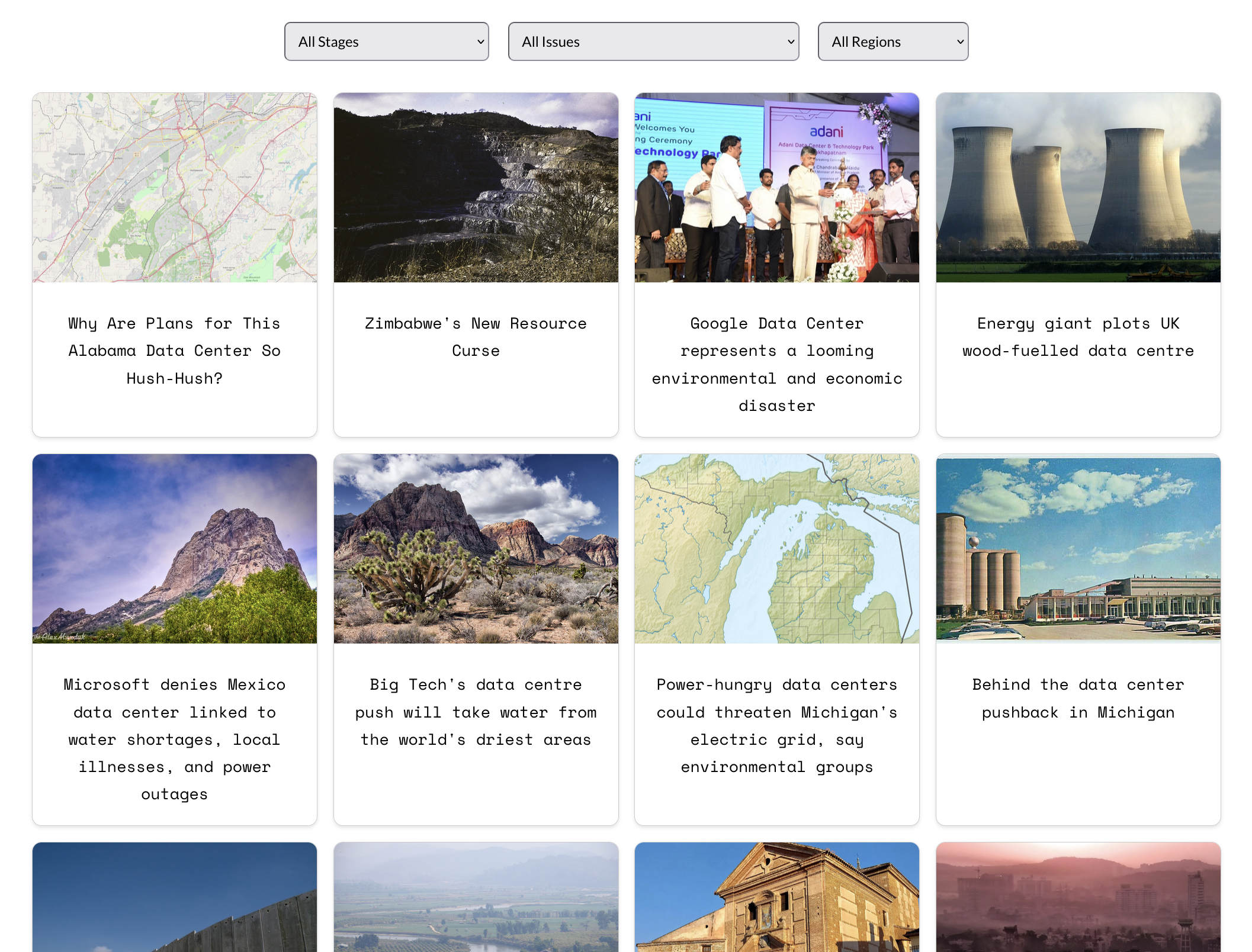
Our continuously updated public repository of cases shows how AI’s footprint plays out on the ground, from data centre strain on water supplies to community resistance against mining and extraction, globally. In the past nine months, led by Beatrice Bacci, we have added and analyzed 51 cases across 12 regions, 9 categories of issues and 6 stages of the AI supply chain.
Reading + Watching + Listening List
We curated a list that is a living document, intended as a shared resource for those exploring the intersections of AI, ecology, justice, and more-than-human perspectives. This list is open for public viewing and collaborative input. Please feel free to leave comments with suggestions, additions, or reflections. The goal is to build this collectively and keep it evolving as the conversation grows. Check it out here!
Research Projects
Our core research initiatives took shape this year, each probing a different material stage of the AI lifecycle:

Rooted Clouds
This project, situated across the Model Training and Model Development research areas, investigates the hidden infrastructure powering artificial intelligence. Far from being weightless or abstract, AI runs on sprawling data centers that extract water, energy, and land–often at great cost to local communities and ecosystems. Led by Nicolás Marín Navas and Lakshmee Sharma, his project maps where these centers are being built, who is driving their expansion, and what impacts they leave behind, making visible the hidden infrastructure–and injustices–at the heart of AI.

Below the Algorithm
Situated within the Raw Material Extraction research area of the AIPJ, this project examines the mineral front end of AI. Lithium, cobalt, nickel, and rare earths are pulled from specific landscapes, diverting water, disturbing soils, and disrupting livelihoods and ecologies. Led by Ambika Varma and Beatrice Bacci, we chart extraction hotspots and expansion corridors, identify operators, buyers, and financiers, and document consequences for people and more-than-human worlds—bringing into view AI’s material beginnings and the inequities they reproduce.

Beyond Binaries
This project, situated across the Model Training and Model Development research areas, investigates the hidden infrastructure powering artificial intelligence. Far from being weightless or abstract, AI runs on sprawling data centers that extract water, energy, and land–often at great cost to local communities and ecosystems. This project maps where these centers are being built, who is driving their expansion, and what impacts they leave behind, making visible the hidden infrastructure–and injustices–at the heart of AI.
Diaries: What We’ve Shared Behind the Scenes
We are committed to transparency — documenting not just polished outputs but process, missteps, surprises, and insights along the way. These include:
Developing an Impact Framework — A look at how and why the AI Supply Chain Impact Framework was created, the choices we made in defining its stages, and the challenges of mapping what’s often invisible.
Introducing Rooted Clouds — Reflections on why we started this project, what we aim to do, and how we’re building an open, collaborative effort.
Introducing Below the Algorithm — Early notes from the research on tracing extraction sites, community impacts, and research hurdles.
If you haven’t yet checked our diaries — they are open invitations to walk with us through what we are learning, unlearning, and building.
Publications & Thought Leadership
Imaginaries of the Future — A fiction reading list made by our Beatrice Bacci, at the nexus of AI, climate emergencies, and technological dystopia. Through novels spanning climate disaster, technological histories, and techno-dystopia, the blog explores how storytelling helps us emotionally and politically engage with planetary crises and possible futures. The reading list includes works by Julia Armfield, Emily St. John Mandel, Jeanette Winterson, R.F. Kuang, Janelle Monáe, and Laila Lalami, among others – stories that foreground lived experience, inequality, memory, and the social worlds shaped by technology.
AIPJ at the Digital Citizen Summit in Hyderabad, India — At the Digital Citizen Summit in Hyderabad, AIPJ highlighted the hidden social and ecological impacts of AI. This is a reflection on the participatory workshop we hosted and a panel we participated in. Discussions focused on alternatives such as smaller-scale AI, meaningful community participation, and governance that treats resources and affected communities as rights-bearing.
From Clouds to Ground: Rethinking Data for AI Through Planetary Justice — In this reflection from the Data for Public Goals event at Politecnico di Milano, we call for a radical reframing of how we understand and govern data for AI. Moving beyond technical metrics and ethical tweaks, the piece introduces a planetary justice lens that traces AI's impacts across its full supply chain–from resource extraction to model deployment. Highlighting the ecological, labor, and epistemic costs embedded in AI systems, the post challenges the narrative of data neutrality and questions the assumption that automation is inherently beneficial. What if, instead of optimizing AI, we asked whether it is needed at all–and who gets to decide?
We Went To Bengaluru, India, and Presented Our Work! — The AI + Planetary Justice Alliance joined researchers, organizers, and practitioners in Bengaluru for the Mapping Data Work workshop — a gathering that foregrounded the invisible labor behind AI systems. In our blog, we report key takeaways, reflect on what it means to build “ethical datasets,” question the assumptions behind datafication, and share insights from our own research on epistemic justice in agricultural AI in India. What if the push to represent is just another form of surveillance? And why are we building AI in the first place?
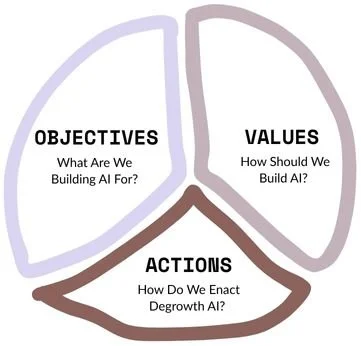
A Degrowth Perspective on AI: ISEE Degrowth Conference 2025 — AI is often seen as the answer to our planetary crises. But what if it’s also part of the problem? In this reflection from the ISEE/Degrowth 2025 Conference, Sara Marcucci argues that AI is not just a neutral tool—it’s a product of growthism and dualism, built on extractive infrastructures and driven by an ideology of more. Drawing on real-world supply chain impacts and grounded community practices, the piece offers a framework for reimagining AI through a degrowth lens: starting with collective purpose, guided by relational values, and enacted through democratic, low-impact practices.
The Planetary Costs of AI: “Atlas of AI” Book Review — AI is not inevitable, nor is it a given. As Kate Crawford reveals in Atlas of AI, behind the sleek interface of artificial intelligence lies a vast network of extraction—of minerals, of labor, of data, of meaning. From lithium mines in Nevada to e-waste dumps in the Global South, AI systems are materially grounded in deeply unequal infrastructures. They are not just powered by code, but by centuries-old ideologies of control, colonialism, and capitalism. This review explores the human and ecological toll of AI’s supply chain and urges a shift from the language of ethics to a critical interrogation of AI’s power.
Events & Engagements
We participated in, organised, or contributed to a wide range of events that built connections across research, policy, and community action:
Mapping Data Work Workshop
Hosted by: University of Amsterdam, Aapti Institute, Tattle | 19 - 20 March, 2025 | Bengaluru, India
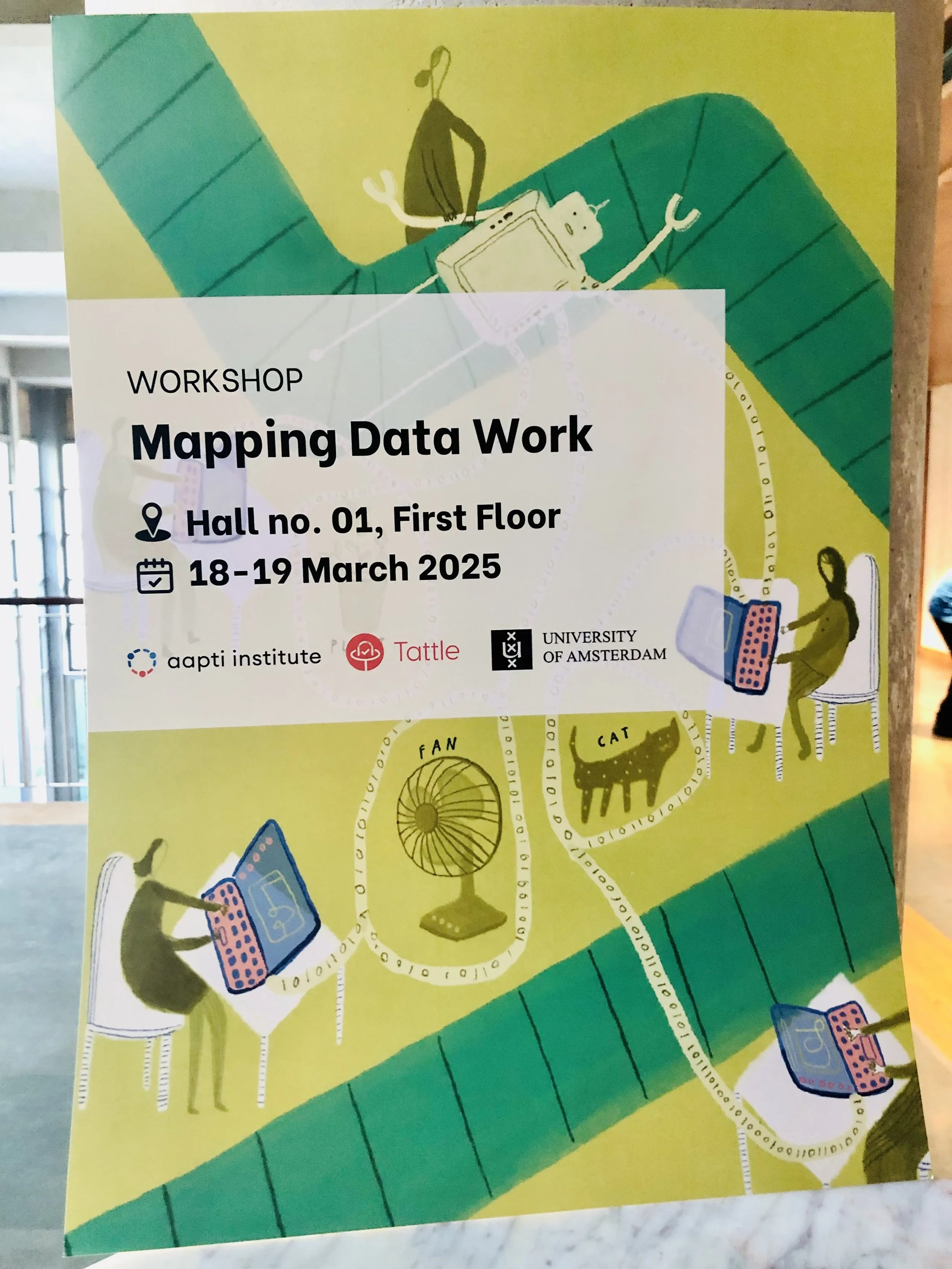
In March 2025, we had the opportunity to present our Beyond Binaries: Epistemic Justice in AI Datasets project at the Mapping Data Work Workshop in Bengaluru, co-organized by the University of Amsterdam, Aapti Institute, and Tattle. This multi-stakeholder gathering brought together researchers, activists, data workers, and designers to collectively explore the often-ignored human and planetary costs of AI.
Altri Mondi, Altri Modi Festival
Hosted by: Altri Mondi, Altri Modi Festival | 11 April, 2025 | Turin, Italy
In April 2025, we had the pleasure of participating in Altri Mondi, Altri Modi, a festival dedicated to political imagination and alternative futures, taking place in Turin, Italy. We joined the debate: “Energy-Technological Transition: Artificial Intelligence, Exploitation, and the Human-Machine Relationship”. The conversation explored the material dimensions of AI and how these intersect with broader technological and environmental transitions.
Data for Public Goals: Impatto sociale di approcci data-driven
Hosted by: Osservatori Digital Innovation, Politecnico di Milano | 9 June, 2025 | Milan, Italy
Organized by Politecnico di Milano, this event explored how data can be leveraged to generate societal value through responsible sharing and use. Our contribution focused on the planetary justice implications of data use and reuse in AI systems, with particular attention to the model training and deployment stages of the AI supply chain.
ISEE Degrowth Conference 2025
Hosted by: International Society for Ecological Economics (ISEE), University of Oslo | 24 - 27 June, 2025 |Oslo, Norway
We presented our work at the upcoming ISEE-Degrowth Joint Conference 2025 at the University of Oslo. Our abstract presentation, “Toward a Degrowth Theory of AI,” explored how artificial intelligence systems—often framed as solutions to climate challenges—are deeply shaped by growth imperatives that drive environmental degradation, social inequity, and epistemic injustice.
Sustainable AI Conference 2025: "Shaping Sustainable AI and its Futures"
Hosted by: Institute for Science and Ethics, University of Bonn | 16 - 18 September, 2025 | Bonn, Germany
Organized by the Bonn Sustainable AI Lab and the Institute for Science and Ethics at Universität Bonn, this conference brought together interdisciplinary voices to critically reflect on the concept and practice of Sustainable AI. We participated to present our abstract: “Reframing Sustainable AI through Degrowth and Planetary Justice”.
From Mines to Markets: Building Transparent & Safe Supply Chains
Hosted by: Embassy of Canada to Italy, United Nations Interregional Crime and Justice Research Institute (UNICRI) | 25 September, 2025 | Rome, Italy
In September, we participated in a high-level roundtable at the Canadian Embassy in Rome, discussing the planetary justice implications and impacts driven by rising demand for critical minerals key to AI development.

Italian Tech Resistance
Hosted by: Italian Tech Resistance Network | 3 October, 2025 | Turin, Italy
Italian Tech Resistance (ITR) is a counter-festival running in Turin from October 1–3, parallel to Italian Tech Week. Backed by groups like Si Cobas, Stop Riarmo, Osservatorio CPR, Torino per Gaza, Confluenza, and HackLab, ITR challenges Big Tech’s narrative with talks and workshops on “social hackers,” bottom-up (civic) AI, digital self-defense, and alternatives to platform monopolies. Organizers criticize the concentration of power, mass surveillance, data centers’ environmental toll, and widening inequalities. The aim is not a one-off event but a permanent hub: drafting a manifesto and building campaigns, labs, and alliances for a rights-protecting, community-led tech model. [Italian only.]
Ethical Consumer Conference
Hosted by: Ethical Consumer | 7 November, 2025 | London, United Kingdom
As part of the 2025 edition of the Ethical Consumer Conference, we will take part in the session “Challenging Land Grabs by New Tech and AI”, where AIPJ’s Founder Sara Marcucci will dialogue with Sebastian Lehuede – Lecturer in Ethics, AI & Society at Kings College, and Casey Weinberg – Director of Development at MediaJustice.
Digital Citizen Summit 2025
Hosted by: Digital Empowerment Foundations | 14-15 November, 2025 | Hyderabad, India
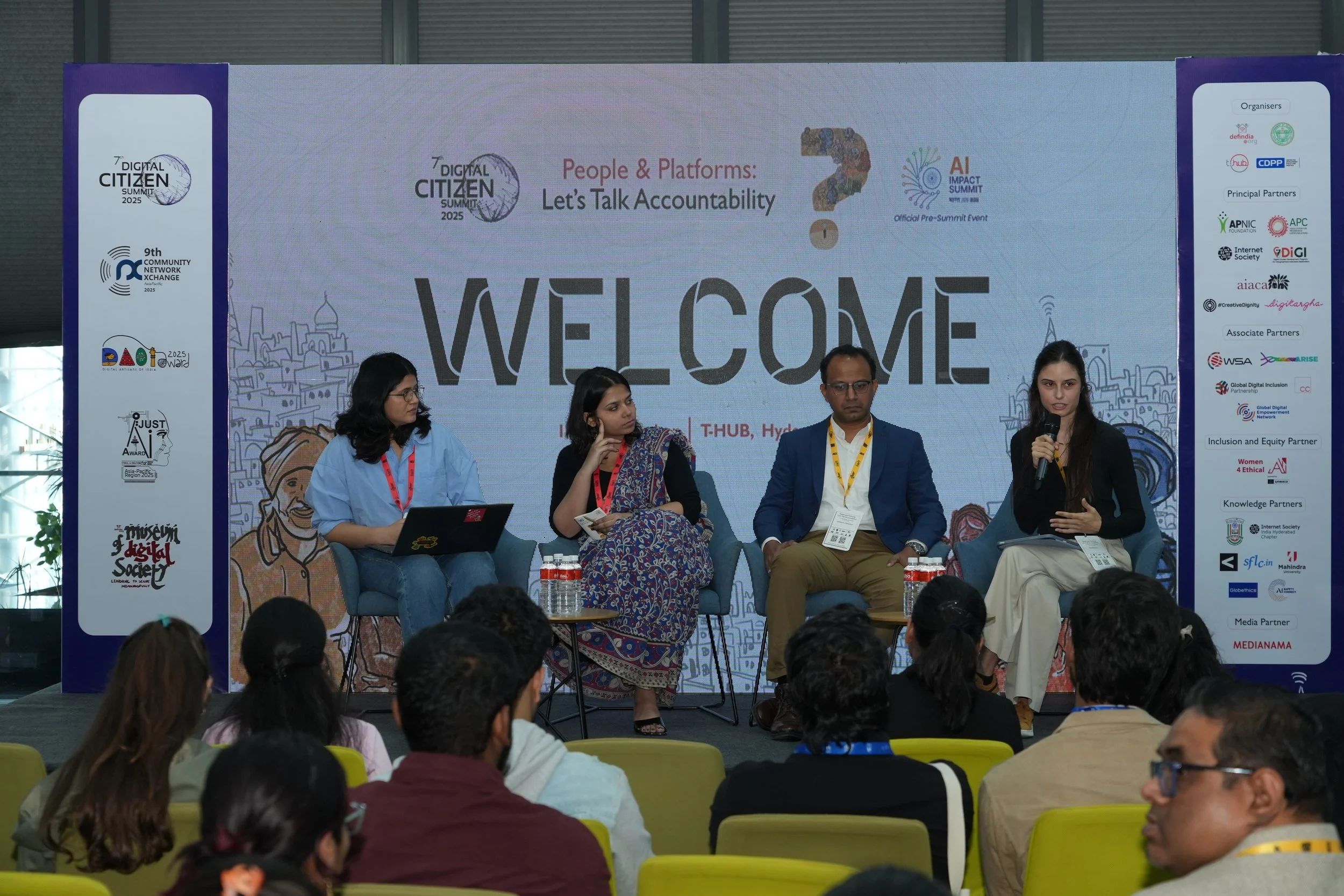
Organized by the Digital Empowerment Foundation (DEF), the 7th Digital Citizen Summit (DCS) 2025 was themed ‘People & Platforms: Let’s Talk Accountability’ and explored how platforms shape power and responsibility in digital societies. Sara participated in a panel and host a workshop in the Just AI – Data & Algorithms for Communities track. The discussion addressed the environmental and social costs of data centres and compute infrastructure, the extractive realities of hardware supply chains, the often-invisible labor behind AI datasets, and the global circulation of electronic waste.
Together with the audience, we also stepped back to ask deeper questions: What kind of technological trajectory are we collectively building? Who benefits from it, and who carries its burdens? And how do we shift toward models of AI development grounded in ecological limits and social justice?
Overall, these spaces helped expand our connections, push our ideas into public and policy conversations, and foreground alternative imaginaries for what just AI systems could look like.
Media & Public Discourse
Conversations about AI’s impacts reached wider audiences this year — and AIPJ’s work featured across several platforms, including:
Truthdig interview: “Can AI Be Just?” — An interview with Sara Marcucci on extractive AI.
Radio Onda Rossa (Italy): An interview with Sara Marcucci on AI and planetary justice.
Digital Law Perspectives Podcast (DCU): Two-part episode featuring Rooted Clouds.
Business Insider contribution: Sara contributed insights on privacy, consent, and AI workforces.
REVOLVE piece by Nicolás Marín Navas: “The Data Centre Dilemma.”
Among others, these engagements helped push critical perspectives into mainstream and specialised media, challenging narratives that treat AI as immaterial or inherently benevolent.
Advocacy & Community Engagement
EU Consultation on the Cloud & AI Development Act
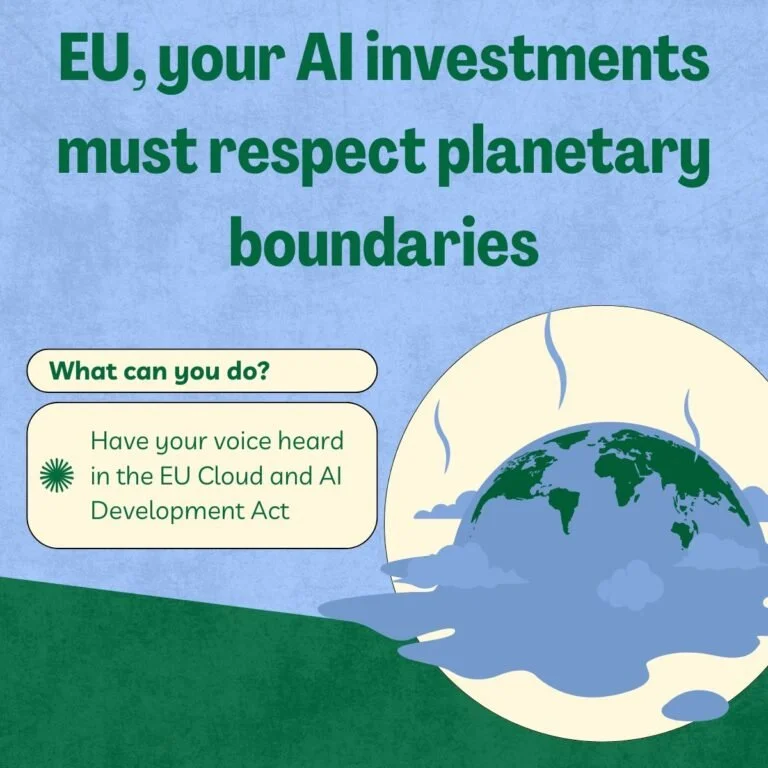
Graphic by the Green Web Foundation. Source.
We’re proud to have contributed to the Green Web Foundation’s collective effort to respond to the EU Cloud and AI Development Act consultation, calling for stronger environmental and climate justice accountability in Europe’s digital infrastructure plans.
The current framing of the Act misses the mark on many key issues, especially when it comes to the climate and justice implications of cloud and AI systems. Alongside 20+ organizations, we helped draft a template response that challenges extractive models of tech development and advocates for meaningful structural change.
Academic & Student Collaborations
University of Sheffield — We’re thrilled to announce a new collaboration between the AI + Planetary Justice Alliance and the Sheffield Digital Justice initiative at the University of Sheffield School of Law. As part of the partnership, we have run a capacity building workshop with Sheffield students and engage them directly in two of our projects: Below the Algorithm and Rooted Clouds. This partnership hopes to build skills, confidence, and community while contributing to open, public-interest research.
Guest Lecture at the London School of Economics and Political Science — Sara Marcucci engaged students in thinking critically about planetary justice in AI, giving a guest lecture in Dr Alison Powell’s Digital Futures class.
Participatory Workshops and Planetary Dialogues
AIPJ Planetary Dialogue
July 2025
The first AIPJ Planetary Dialogue saw the introduction and presentation of the AIPJ Alliance and its team, and invited participants to test, challenge, and expand the AI Supply Chain Impact Framework through a participatory, co-creative process. The session engaged the experts in a live, structured exercise to identify missing impact areas, refine the framework’s dimensions, and propose alternative ways to assess AI’s real-world footprint. This feeds into our effort to foster bottom-up, collective knowledge production, ensuring the framework remains adaptive, critical, and reflective of diverse perspectives.
AIPJ Participatory Workshop at the Digital Citizen Summit
November 2025
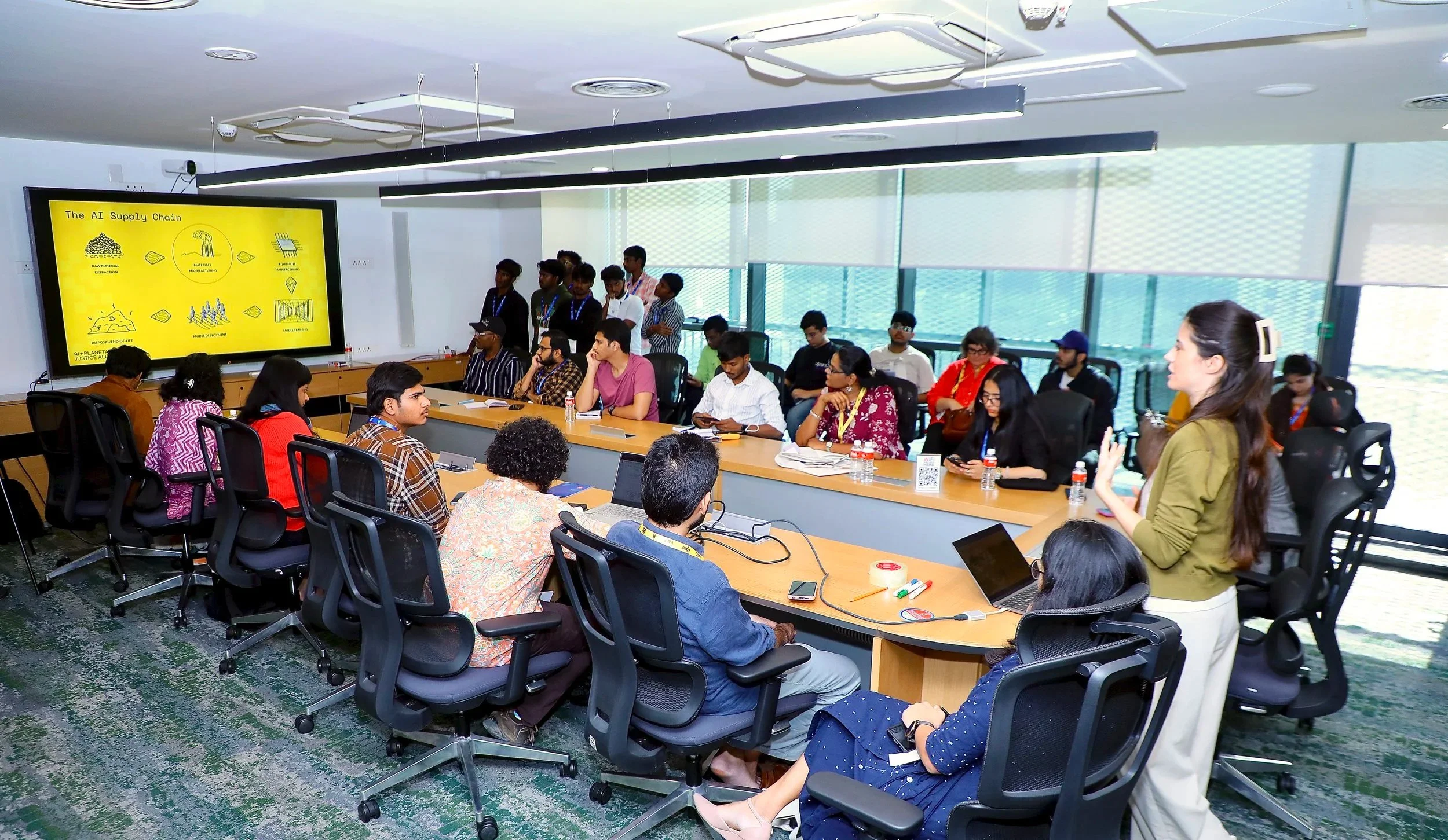
At the DCS 2025, in Hyderabad India, we led a participatory workshop exploring the AI supply chain—from mineral extraction and hardware manufacturing to data centres and e-waste—using our AI Supply Chain Impact Framework to map environmental, labour, and community effects and discuss local strategies for equitable infrastructure.
Team Growth
From launch to year’s end, AIPJ expanded into a team of nine dedicated researchers and collaborators — each bringing unique expertise spanning digital politics, ecology, justice, and material-grounded AI critique. See our full team here!
What’s Ahead for 2026
We have so much in the works — new research strands, new projects and collaborations, expanded public resources, and continued community engagements. We can’t wait to share more with you.
Subscribe to the AIPJ newsletter for monthly updates!
