
Reflections from the Student Workshop at the Centre for Computing History
Last week, I had the opportunity to represent the AI + Planetary Justice Alliance at The Centre for Computing History (Cambridge, UK) Schools’ Day, as part of the “Broken Tech, Broken Earth” (BTBE) project at the museum led by coordinator Nadirah Hussain.
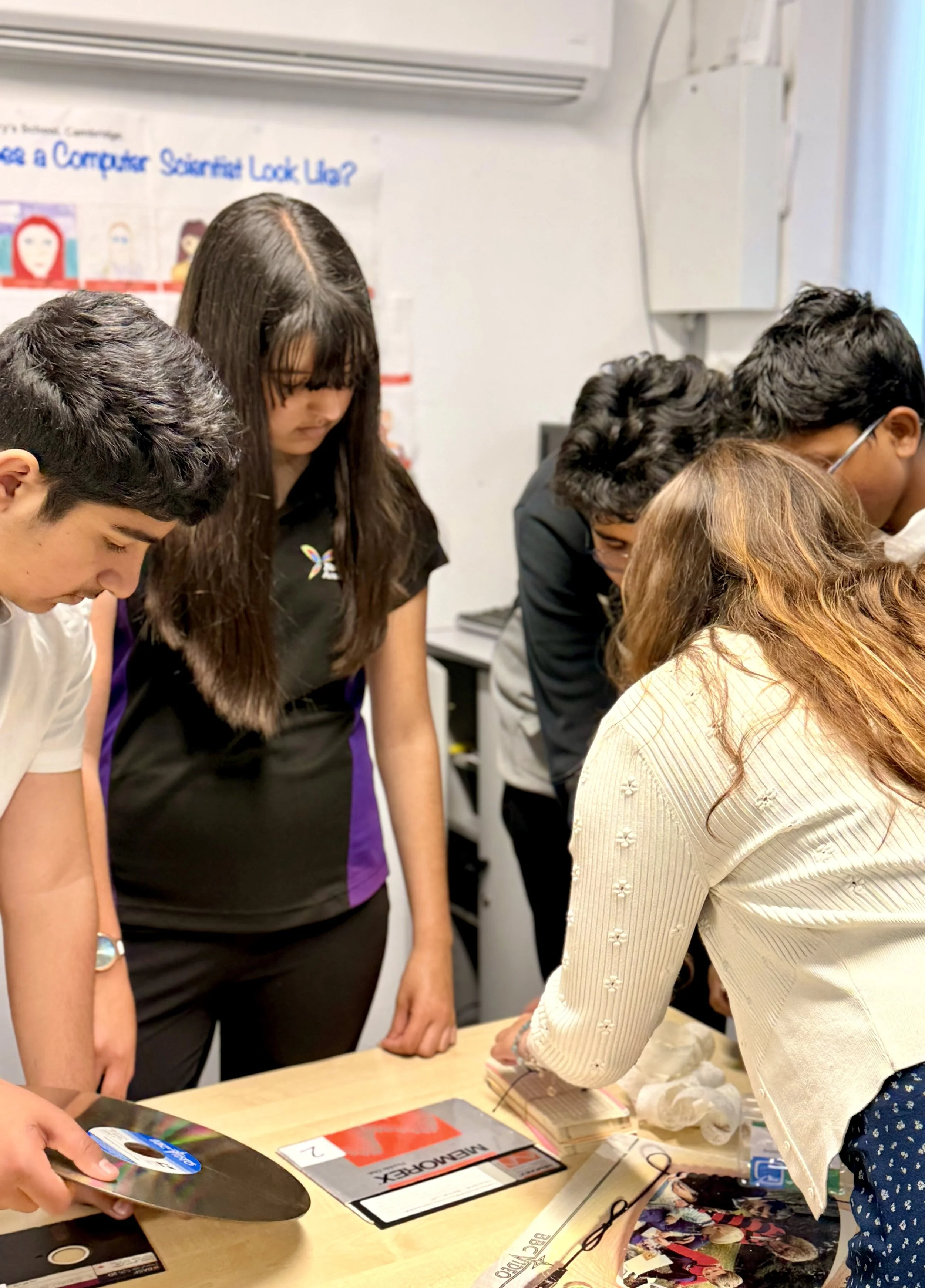
That day, the museum and volunteers welcomed 67 primary and secondary school students (ages 10-14) from the local Cambridge area for a fully subsidized educational visit.
Part of the Centre for Computing History’s mission is to make educational events and especially school visits accessible for all – indeed, at the workshop, a high proportion of the students were eligible for free school meals.
The day included a series of workshops for each age group to engage students with the BTBE themes of the environmental and social dimensions of digital technology.
One of my personal favorites was the volunteer-led ‘Discovery Box’ workshop, where the kids examined older technology, many pieces now deemed obsolete, like punch cards. The workshop prompted really interesting questions about the sustainability implications of older digital formats, from punch cards to floppy disks to microchips.
The AIPJ Workshop
The AIPJ workshop, co-designed with director Sara Marcucci, was developed to highlight the social and environmental dimensions of technology across AI’s supply chain. Going into the workshop, I was initially a bit nervous. I had done similar workshops on the environmental and social impacts of AI with university and even high school students before, but never with primary and secondary school students. When planning the presentation and activities, I worried,
“How much do 10-year-olds know about AI?”
“How do you explain the environmental impact of data centers to early teens?”
Once I got into the workshop, though, I can say that my fears were misplaced. All the students had a rich understanding of what AI is and, unsurprisingly, used GenAI for many things, such as homework. I even had some primary students talking about the differences between DeepSeek, Grok, and ChatGPT.
What is AI?
Our first activity was an icebreaker, in which I asked the students to write down “What is AI?” to them.
What models do they know of? What does it look like? What do they use it for?
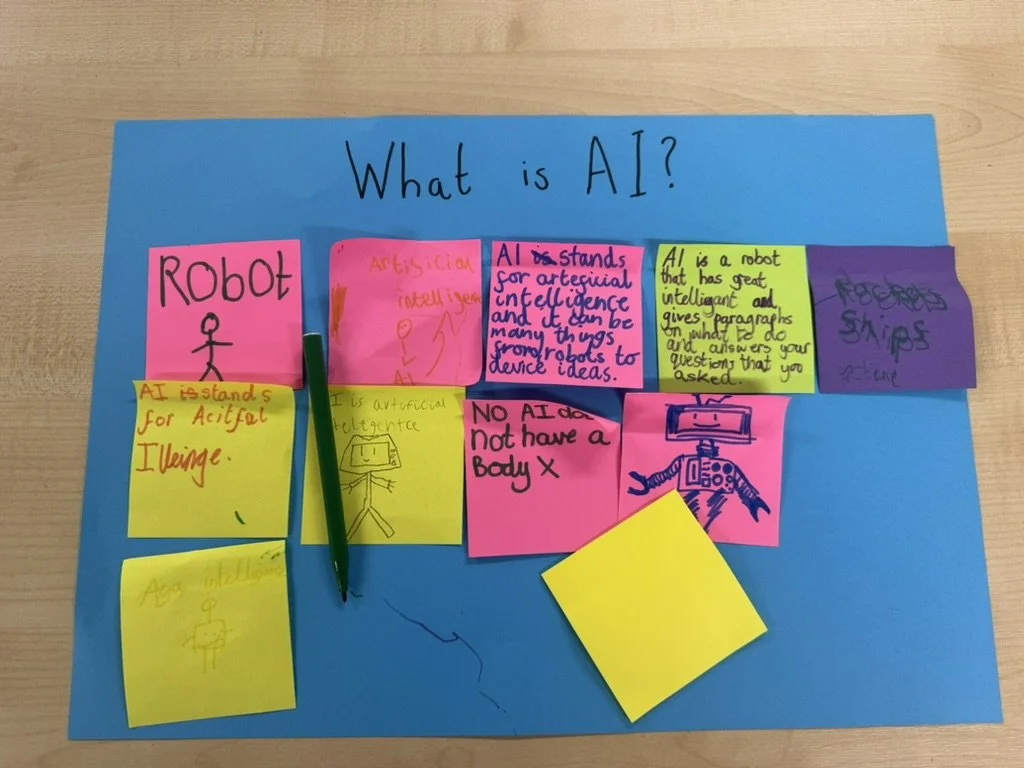
Responses to the “What is AI?” Icebreaker from some of the primary students
We started with this icebreaker because it’s important to understand their baseline perceptions and images of AI before engaging in the other activities. Here are some of their responses:
Primary School Students:
“AI stands for Artificial Intelligence”
“Artificial Intelligence created by humans”
“Artificial Intelligence: A computer designed to help humans (and possibly take over the world”
“AI is a robot that has great intelligence and gives paragraphs on what to do and answers your questions that you asked”
Secondary School Students:
“AI is Artificial Intelligence. They take all of our RAM and GPUs”
“AI is something made by a robot”
“To do my homework”
“Helpful”
“AI is for asking a question”
“Something that tricks your brain . . .”
“ . . . AI is replacing a lot of everyday stuff. AI is used for recipes, photo, homework, etc… In the future AI might replace everything.”
“Wrong a lot. Uses too much water”
“AI is artificial intelligence that some people use to cheat on tests or homework! I use it for study to know how the formulas work to work out a question. What it looks like for me it looks like a study app to help with formulas . . .”
Many of the students shared that they use GenAI for school and homework. Many kids these days don’t remember school without digital technology or the presence of AI, and are being told they must reskill for the age of AI. However, as BTBE coordinator Nadirah Hussain noted after the event, many secondary schools in the UK do not offer GCSE Computer Science, and “even when the subject is offered, many schools in disadvantaged areas including North Cambridge Academy are restricted due to shortages of qualified computer science teachers.”
Even when students aren’t learning Computer Science or engaging with critical AI studies, GenAI is shaping how and what kids are learning in school. This is why it’s even more important to build a creative and critical understanding of how to look beneath the surface to examine the material dimensions of the ‘cloud’ and digital technology, question technosolutionist narratives of AI, and use AI tools responsibly.
Does AI have a body?
In the next activity, I presented the kids with statements and asked them to move to one side of the room or the other depending on whether they thought it was ‘True’ or ‘False.’ The statements were intended to encourage dialogue about different stages of AI’s supply chain (as laid out in further detail in AIPJ’s AI Supply Chain Impact Framework)
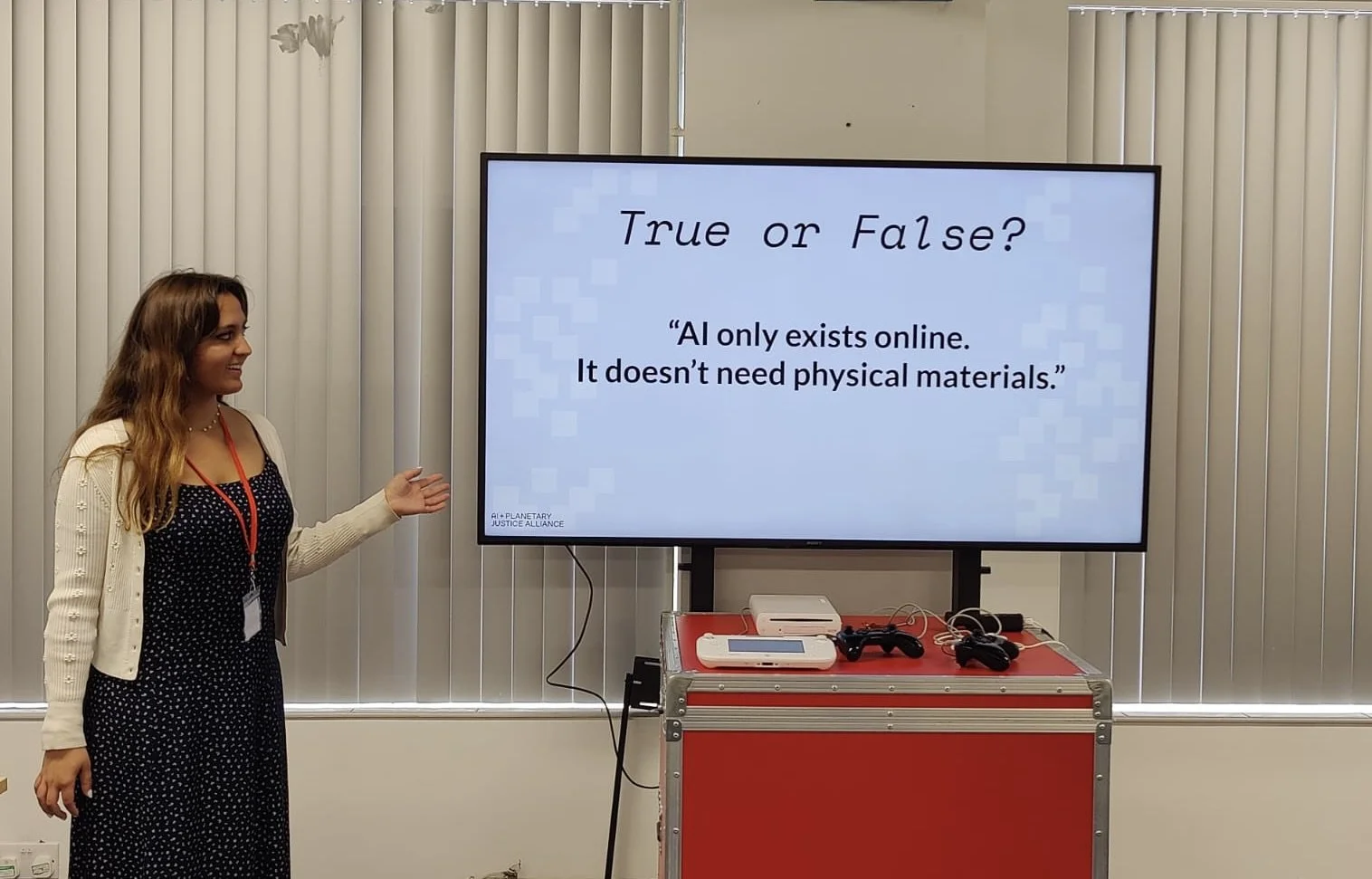
It was great to see the kids engage and debate with the True/False questions and change each other’s minds before the answer was revealed. I was energized by the ways the kids did not stick to a static view of the world, especially when it comes to reimagining the planetary justice dimensions of AI from material extraction to electronic waste.
Local Data Center Development Scenario
For the next activity, I presented the kids with an interactive scenario that engaged with different social, environmental, and economic perspectives on data center development in the Cambridge area.
“Is this real?” the students clarified, “No, it’s not real, but it could be,” I replied, knowing that there are already several data centers and colocation sites in the Cambridgeshire area and some planned, such as the AiOnX 330MW hyperscaler. However, the parameters of this activity were purely hypothetical.
The students were split up into groups representing the interests of the following groups:
AI / Tech Company;
Local Community;
Environmental Groups;
Consumers / Industry.
The students engaged with the scenario and reflection questions from the perspective of their assigned groups. After the initial chaos of transitions with young age groups, the kids dove into the questions and even added their own new ideas based on our conversations throughout the workshop.
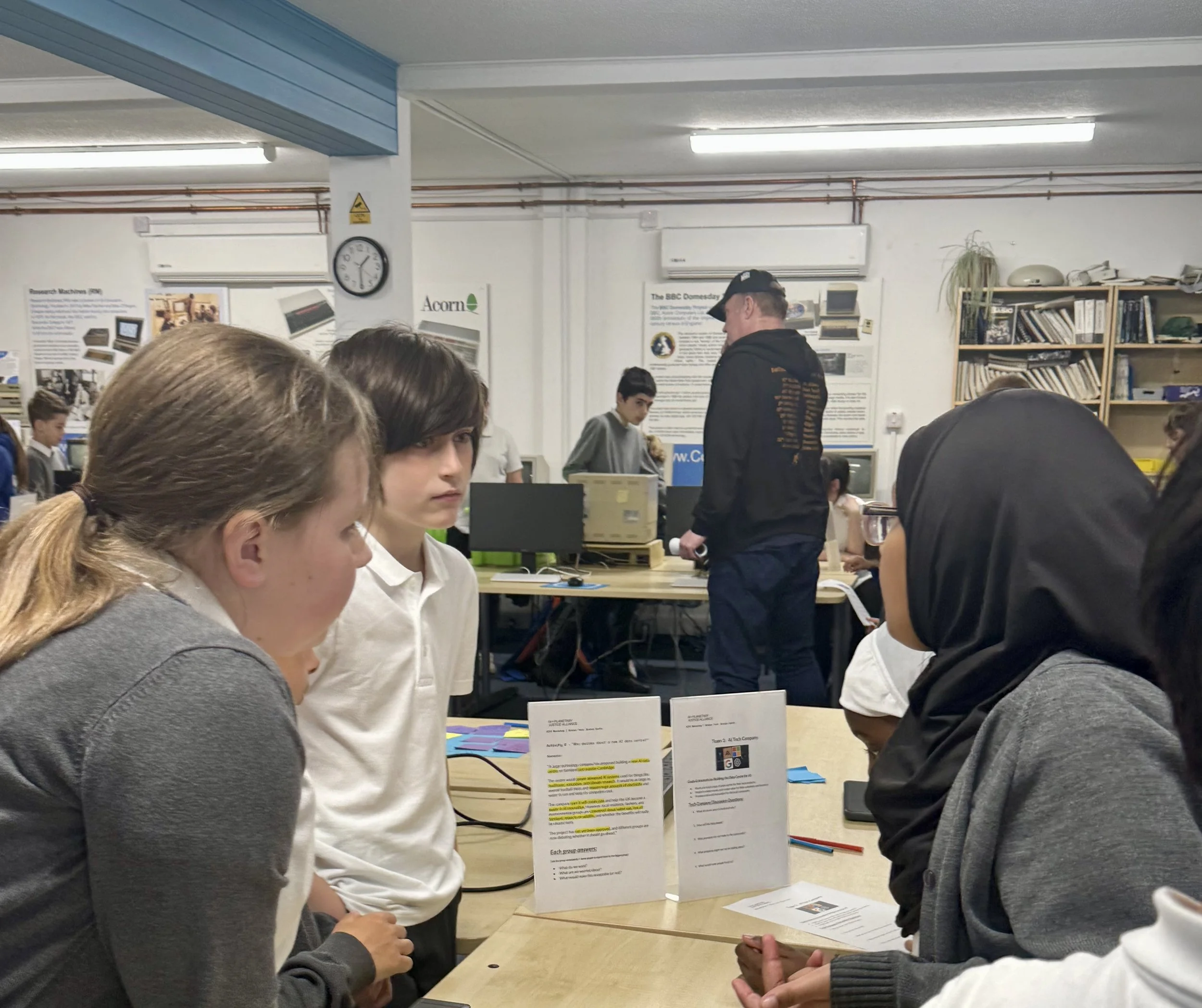
For the tech company groups, some students included points about how they could include the local community in their development plans. This is a critical step in any multistakeholder development process, but is often overlooked in data center development.
In the case of the local community groups, the primary school group wanted to ask the Tech company, “Why choose Cambridge?” I prompted them further and asked, “If not Cambridge, then where?”
I feel like this is an important but often overlooked question in critical data center discourse. Especially when ‘Not In My Backyard' rhetoric can often dominate the data center debate. Communities need to ask: ‘How can we have local oversight of data centers?’ And if opposition forces the data centers to be moved elsewhere, how can those new locations be optimized for environmental and community concerns so they are not perpetuating cycles of environmental injustice that exploit low-income and communities of color? One of the many examples of this from earlier this year showed that after a predominantly white, affluent South Carolina town rejected a data center, the project was moved to a lower-income community of color.
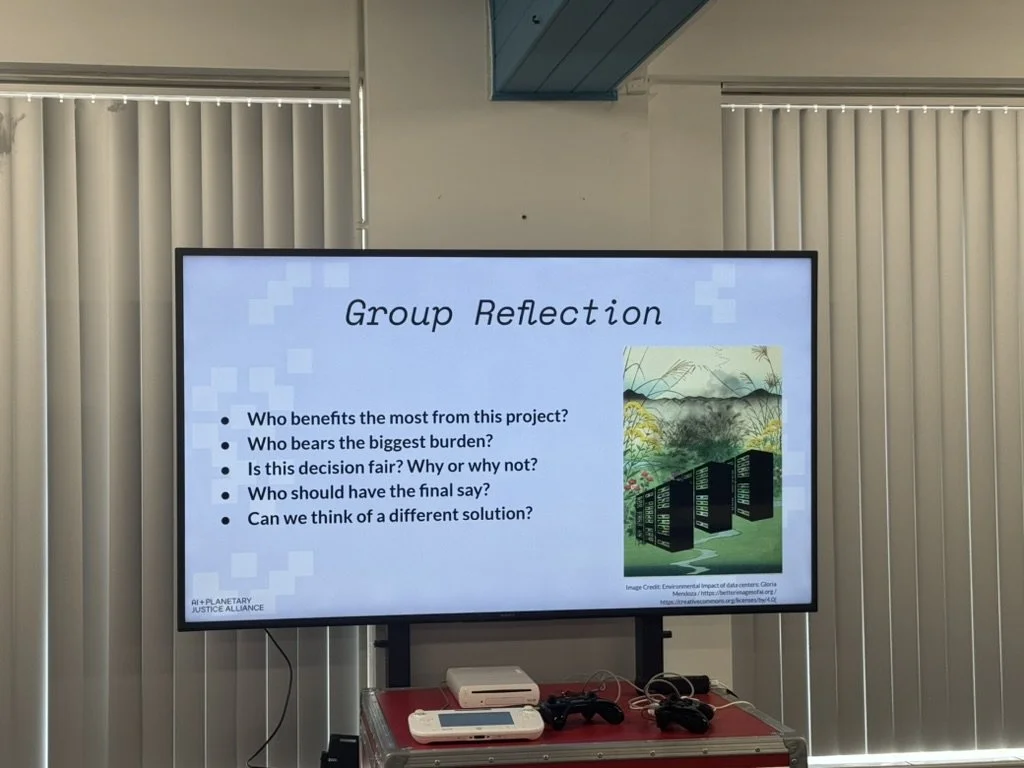
Encouraging democratic engagement and collective governance strategies is so important, but often very difficult for large infrastructure projects backed by international tech companies with billions of dollars at their disposal. Seeing the kids creatively think about ways to improve data center development to include environmental and social concerns, and to see how the benefits of AI can be distributed more equally, was so energizing.
The Consumers and Industry Team, the final group to share in the Secondary School workshop, ended on a powerful note, saying:
“To most everyday people, AI is just a helpful source that answers our questions. However, we all know that AI comes from so much more that’s damaging our earth.”
Final Reflections
It was amazing to see the kids discuss the trade-offs between AI’s convenience and its planetary impacts, and to brainstorm ways they can be more discerning consumers of AI in the future. As kids use GenAI in their everyday lives and education, it’s critical that they also learn about the water, energy, mineral, and labor dimensions that are so often overlooked in popular AI discourse.
AIPJ is committed to rigorous research that is presented in creative, engaging, and accessible formats for public-facing audiences. Especially when widespread AI hype can so easily cloud the environmental and social impacts of AI development, education, whether in the classroom or the public sphere, is even more critical.
We are excited to be part of the Computing History Museum's amazing work to make these activities accessible to students. As usual, don’t hesitate to reach out if you or someone you know is interested in partnering with AIPJ for other educational workshops or curriculum development!
