
Observatory Zoom In: London Data Centres
Our Observatory of Planetary Justice Impacts of AI aims to make visible the impacts of the AI supply chain on human and more-than-human communities on the planet. This month, instead of a roundup of the main cases we’ve found, we are putting the spotlight on one particular case: the 50 to 60 new data centres being built in and around London.
Concerns Raised Over Impact Of New Data Centres On London’s Energy Supply
By Kumail Jaffer
Stage: Model Training, Model Deployment
Between 50 and 60 new data centres are planned to be built in and around London, which is projected to put the city under pressure due to the high amount of energy they need. It is estimated that every 10 of these will emit 2.7 million tonnes of carbon. Oliver Hayes, head of policy and campaigns at Global Action Plan, added: “Data centres also need to be confident they can run the entire time, so they all have backup generators on site – usually in the form of diesel generators. This again has additional impacts for climate, but clearly, particularly in a London context, risks undermining the progress that we’ve heard about on air quality.” There is also a concern surrounding London’s housing crisis, as the London Assembly Planning and Regeneration Committee reported that some new housing developments in West London were temporarily delayed after the electricity grid reached full capacity.
From Beatrice
As a Londoner, I had a particular interest in finding out whether any part of the AI supply chain was passing through London materially. London certainly has a concentration of capital that is being invested in AI and its supply chain, but it’s the materiality of it, and how close it is to me, that I wanted to look into. I came across this article and was struck by the mention of impacts of data centres on housing in London - a city with a huge housing crisis, which impacts me personally. This led me to find more information on data centres in London, and to put together here an analysis of the current impacts felt by communities across the city.
Data Centre Sites of Interest
Brick Lane
The historic Truman Brewery, which currently houses a vintage market, pop-up shops, bars, and restaurants, has submitted a redevelopment proposal to be turned into a data centre - a proposal which was rejected by Tower Hamlets Council last year. However, Truman Estates, which owns the land, has appealed the decision, and it has been called in by the UK’s Secretary of State for Housing, Steve Reed. This means the minister could overrule the local authority and give the project the go-ahead. Details of planned capacity for the data center, or how it would be powered, were not specified. The brewery site has been central to Brick Lane’s growth as one of London’s most vibrant areas for independent shops and restaurants. The petition to stop the data centre, signed by over 1,700 people, states: “Brick Lane is not an abstract development site. It is a living cultural, social, and economic ecosystem with deep historical significance and an internationally recognised identity.” Moreover, the local community has submitted a proposal commissioned by the council, which could accommodate 350 homes, including 44 for social housing. Tower Hamlets reportedly has more than 28,000 families on the council housing waiting list.
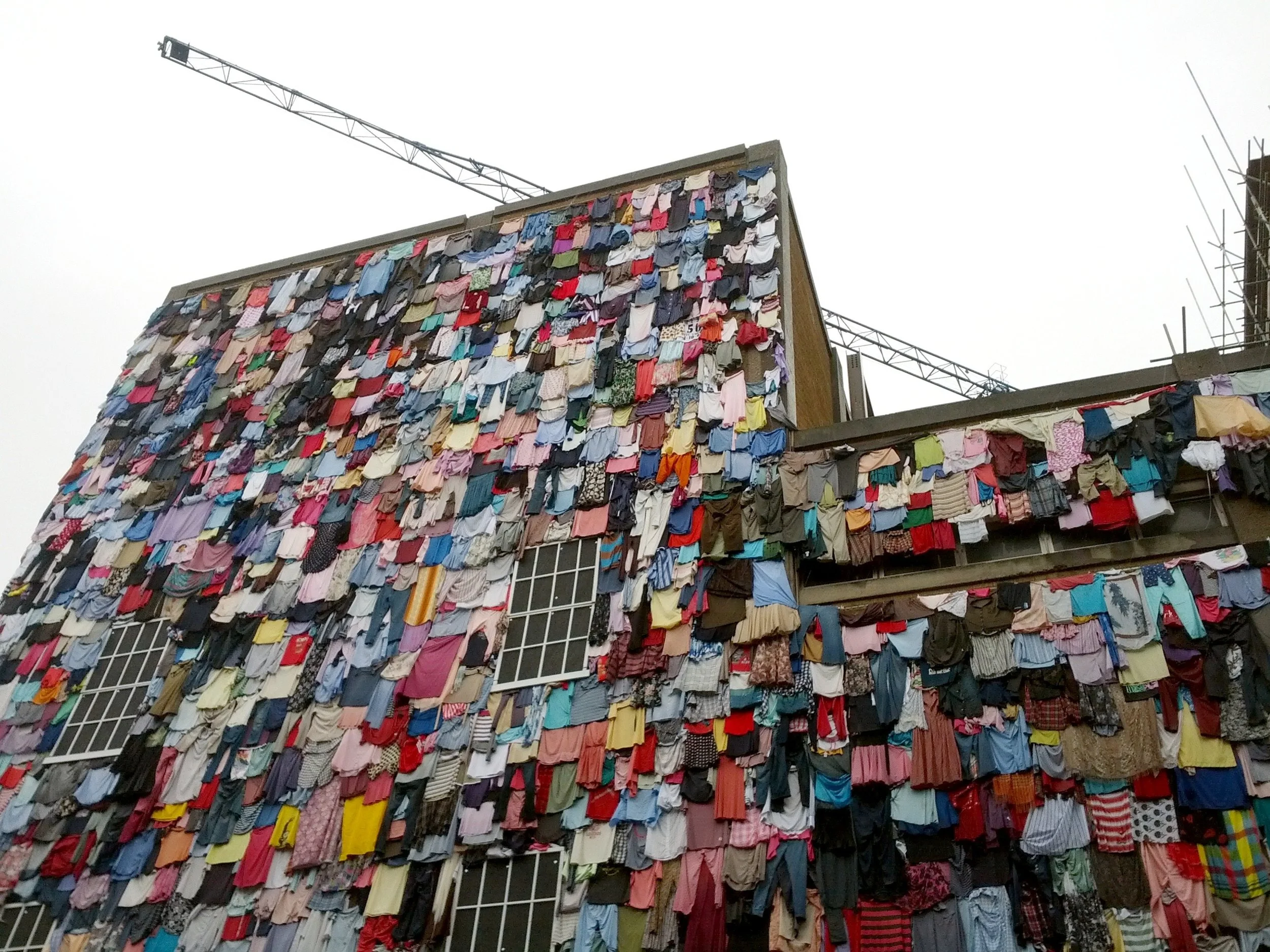
"Shwop used clothes building takeover 3, Truman Brewery, Brick Lane, London, UK" bygruntzooki is licensed under CC BY-SA 2.0.
North Ockendon
In the Green Belt, the forest and farmland area established around London in the 50s, Digital Reef has proposed a 218-hectare data centre campus called East Havering Data Centre, which is to be the largest in Europe. The local community has been concerned about the plan since it was unveiled in 2024. That summer, Havering Friends of the Earth co-ordinator Ian Pirie said the impact on the site would be “unacceptable”. “Instead of farmland, there will be a large number of warehouse-sized buildings, containing banks of computers, batteries, cooling systems, backup power sources, and more equipment.” The data centre is projected to consume 600mw of electricity from the Warley sub-station, which will not produce its completely renewable target for years to come. The community is also concerned about water consumption, flooding risks, lowering property value, noise pollution, and the destruction of a not-insignificant area of Green Belt. The public consultation on the project remains open until April 7th.
Potters Bar
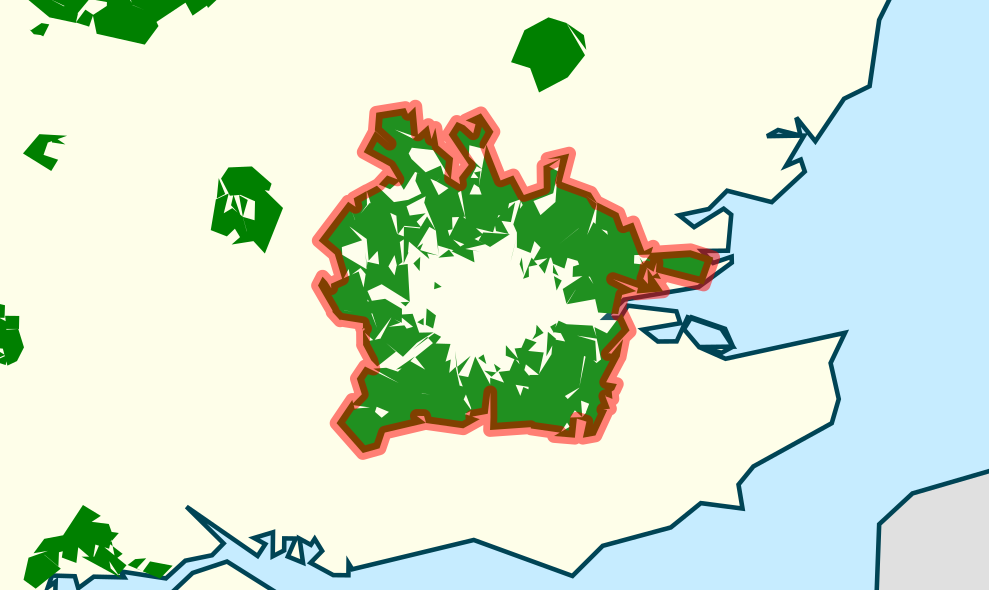
"The Metropolitan Green Belt among the green belts of England" byHellerick is licensed under CC BY-SA 3.0.
Another Green Belt development is the Hertfordshire Campus near Potters Bar, proposed by Equinix. Smaller than North Ockendon, this plan covers around 18.5 hectares of farmland in the Green Belt, roughly the size of Wembley Stadium. The plant will require 250mw of power. Local objectors express opposition to the loss of “incredibly precious countryside.” The Save 85 Acres Of Greenbelt In Potters Bar campaign group states the following impacts on the area and the community: destruction of 85 acres of local environment, loss of biodiversity and wildlife, loss of valuable greenbelt, noise, air and light pollution, huge amounts of power usage, loss of 40 oak trees, all over 150 years with the oldest being 240 years old, disruption of 11 public rights of way for equestrians, walkers and cyclists, community groups, scouts and schools, and minimal jobs and hire advantages. They are worried about the proximity to Dame Alice Owens School, with possible physical and mental health repercussions for students and local residents. They also dispute the 'new grey belt' terminology and classification and lament inadequate community engagement. An archaeological field inspection is taking place, with an ecological survey to follow in May. Equinix aims to submit a detailed planning application in August/September.
Waverly Estate
Residents of the Wesley Estate in Park Royal, West London, are facing multiple data centre plans surrounding their community. “Residents say the Frogmore scheme would be the eleventh data centre in the Park Royal/North Acton area. With the Vantage Data Centre on North Acton Road recently completed, and a Microsoft facility on Volt Road/Bashley Road due to open in January 2026, locals fear being hemmed in by large-scale developments. If approved, the Frogmore site would place three centres within half a kilometre of the estate,” reports the Acton W3. Locals express concerns around the use of diesel backup generators, emitting nitrogen dioxide and particulate matter. They also complain about the dust, noise, and vibration of the building sites. Thames Water has also raised the issue that the existing water supplies cannot accommodate additional demand. Campaigners also argue that there hasn’t been a meaningful consultation, especially one that takes into account the cumulative impacts of the multiple developments. The council has approved the latest development in the area, while the community continues to struggle to pose opposition.
Iver
The government conceded in late January that it made a “serious logical error” in overruling opposition from a local council to grant permission for a hyperscale datacentre known as the West London Technology Park, proposed on the former Woodlands Park landfill site in Iver, Buckinghamshire. Campaigners including Global Action Plan and Foxglove took the government and developers to court over the decision, arguing that the developers’ projections of environmental impacts had not been properly assessed and compared to similar scale data centres. Barrister David Wolfe KC, for the two campaign groups, said only the electricity needs of the office buildings were considered, rather than those of the actual servers and cooling systems. The energy consumption of the potential plant is yet unclear, but likely to be many times the stated amount. While the government has conceded, the developers continue to argue the case, and a hearing in April will potentially give a precedent-setting decision on what the criteria should be for the government or other planning authorities approving data centre applications.
Planetary Justice Impacts of London Data Centres
To explore the impacts of these planned or built data centres, I spoke with Owen Espley, Campaign Manager at Global Action Plan, about the days of action against data centres they organised in February, and to learn more about the local communities facing these development plans.
Here is an overview of the impacts that have been identified so far.
Environment
Heat output (Brick Lane)
Data centres contain servers, graphics processing units and other equipment needing large amounts of power and generating intense heat. Cooling the equipment raises costs, adds strain on the electricity grid, and adds to carbon emissions.
Habitat destruction (North Ockendon, Potters Bar)
Vast areas of farmland, marshland, forestry and natural parks are being designated to be replaced by data centres, with some effort to use some of the land for “ecoparks.” Communities feel that the reduction of the ecosystems could still have devastating effects on the local fauna and flora.
Flooding risk (North Ockendon)
The land on which the data centre is proposed is a fen, a water-logged area fed by groundwater and rainfall. The stability of the land is at risk, as well as its ability to contain and absorb water that would otherwise flood infrastructure.
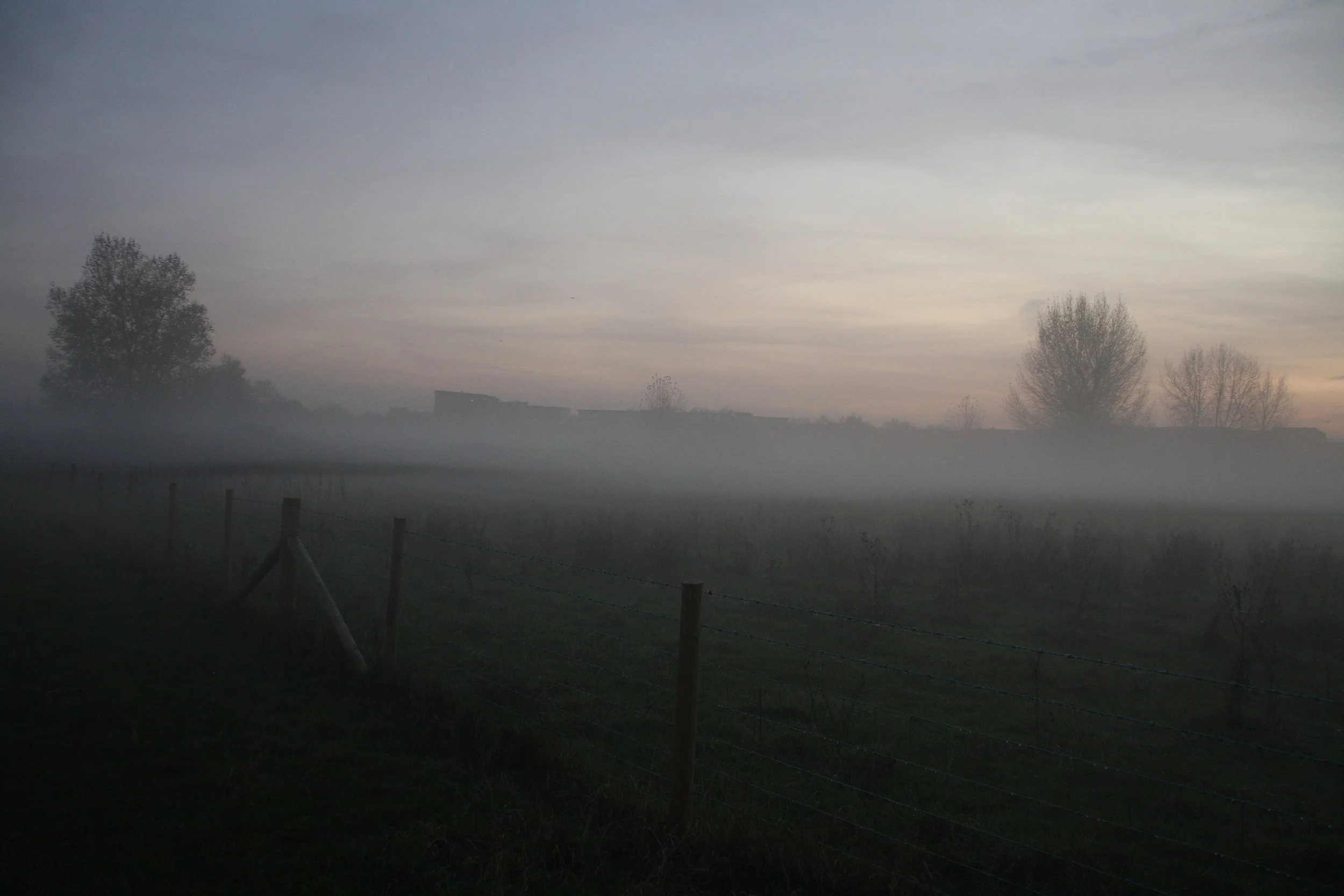
"Walthamstow Marshes" byMatthew Black is licensed under CC BY-SA 2.0.
Pollution (Potters Bar, Waverly Estate)
A significant part of the pollution emitted by data centres is due to the use of diesel backup generators, which are needed in any case where the electricity supply might fail or need to be supplemented. These generators emit nitrogen oxides, carbon dioxide and particulate matter. Investigations from last year have also revealed the use of Pfas, or “forever chemicals” in cooling systems. These chemicals cannot easily be broken down or disposed of, so they accumulate in the environment and in the human body. Some of them are greenhouse gases, which contribute to the rising Earth temperatures, while some are documented to be harmful to the human body.
Energy consumption (Brick Lane, North Ockendon, Potters Bar, Iver)
A hyperscale data centre consumes a huge amount of continuous power, putting strain on the local electricity grid. For context, the UK energy regulator Ofgem revealed in a consultation that 140 new data centres are seeking grid connection in the UK, which would require 50GW of electricity - while a peak winter day in the UK currently requires 45GW of the national grid. The electrical capacity would need to more than double in an extremely short timeframe.
Carbon emissions (Brick Lane, North Ockendon, Iver)
As we explored, data centres emit carbon dioxide themselves when they use diesel backup generators, but of course the electricity they consume is also responsible for carbon emissions. The UK now produces roughly half of its electricity from renewable sources, but the growth of the sector is not comparable to the data centre rush, meaning the national carbon neutral targets would face significant setbacks.
Water consumption (North Ockendon, Waverly Estate)
While we don’t particularly think of the UK as a dry place, there are parts of the country which do encounter drought in the summer. We have very little data on water usage from existing data centres in the UK, with only a voluntary survey of 73 sites (there are around 500 operational facilities in England). Thames Water, the principal water supplier, has now raised the issue that the existing water supply cannot meet additional demand.
Community
Pressure on local infrastructure, transport, and public services (Brick Lane, North Ockendon, Waverly Estate)
The building of hyperscale structures requires a huge amount of material and equipment to be delivered, increasing traffic congestion on narrow country lanes or busy inner city streets.
Undermining of historic character, independent businesses, and cultural heritage (Brick Lane)
Each area has its own character, which can be quite integral to the community identity. Especially when a space is being used for economic activities, fostering independent businesses, the displacement of those activities can cause a huge detriment to the community. Brick Lane has long been shaped by a strong South Asian community, whose presence is embedded in its social and economic fabric. The pressures of gentrification – of which this development is emblematic – risk displacing these communities and undermining the conditions that have enabled them to sustain and reproduce their cultural and economic life in place.
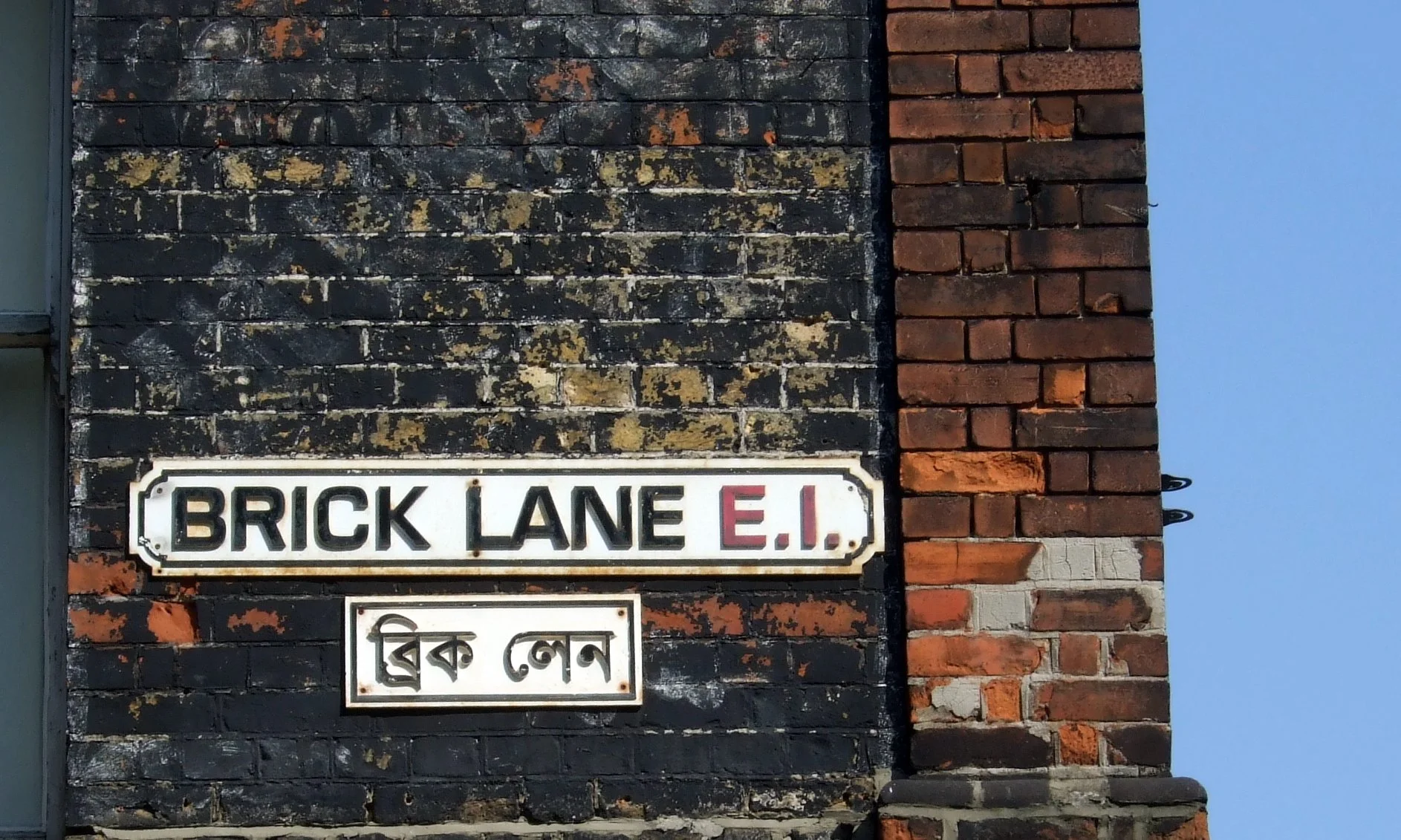
"Brick Lane street signs" by James Cridland is licensed under CC BY 2.0.
Disruption of public rights of way (Potters Bar)
Paths that are being used by walkers or cyclists, especially in nature, are very precious to maintain people’s access to nature and countryside, preserving their habits, their health, and their mental health.
Noise pollution (North Ockendon, Potters Bar, Waverly Estate)
Data centres reportedly emit a constant noise, sometimes a low hum, otherwise a high pitch, which can negatively affect those who live or spend a lot of time near them, especially their hearing and their mental health.
Housing
Displacing the local community (Brick Lane)
Community displacement is a well-tracked impact of the AI supply chain in our Observatory. In this case, the community has been trying for years to use the space for affordable housing, which they are in dire need of, while the denial of such housing to use the space for a data centre would very clearly add to the gentrification of the area and push people further away. Racialised and lower class people are being disproportionately affected by this development, with fewer means to offer resistance.
Affordable housing pressures (Brick Lane)
In December 2025, the London Assembly Planning and Regeneration Committee, published a new report, Gridlocked, highlighting how the growing electricity demand of data centres was a key factor contributing to delays in new housing delivery. Parts of the West London electricity grid, especially in Ealing, Hounslow and Hillingdon, reached full capacity in 2022, halting new housing developments. The Greater London Authority has been working on temporary fixes; however, long-term strategic planning will be needed to avoid putting further pressures on housing.
Temporary displacement while the site is developed (North Ockendon)
Residents are concerned that the workforce required to build the data centre would temporarily increase the pressure on housing, driving rents up and displacing local residents.
Decreased property value (North Ockendon)
Residents have tracked the property values of other neighbourhoods around data centres, and found that those values have gone down - they are therefore worried that their investments will depreciate following the building of the data centre.
Resources & Resistance
All of these communities are campaigning for more transparency and to have more of a say as to whether they can absorb the pressure a data centre would bring to their area. They need planning and environmental expertise to be able to properly assess the proposals, so if you have those skills, please get in touch with them!
North Ockendon
The public consultation is currently happening, so start here! This website collects all the documents that have been supplied to the community and explains how to send objections and how to contact the campaigning group. You can also get in touch via the Facebook group.
Brick Lane
Sign the petition. You can also send a request through Change.org to get in contact with the organisers.
Potters Bar
Sign the petition. Get in touch via the Facebook group.
Waverly Estate (Frogmore data centre)
Documents included on the Mayor of London planning platform.
Conclusion
As always, the purpose of the Observatory is to track the material impacts of the AI supply chain. The conversation in the UK has mostly revolved around remaining competitive in the AI age, but it should also revolve around the material consequences of the AI rush. The energy, water, and housing infrastructure needs to expand dramatically to make space for an industry that requires a significant amount of electricity, water, and land - and it’s becoming increasingly clear that this is not sustainable at the current rate. The image of AI happening in ‘the cloud’ has been greatly influential to erase this material aspect of the industry. By zooming into these particular cases, we aim to make visible this materiality, which communities are being affected, and how these impacts intersect along race and class lines to disproportionately affect those communities. At the same time, it is essential to zoom out: the accumulation of impacts on different communities requires much more strategic planning than what has been done at the national level. Decisions taken at this stage will affect the development of data centres for years to come - it is critical to make sure that community needs are prioritised, including access to housing, electricity, and water. The new London Plan, a draft of which we are expecting this summer, should give us an indication of where the city is headed; however, national planning is also needed. Data centres have been classified in planning applications as general B8 storage class (i.e. the same as warehouses). They are now classified as Critical National Infrastructure, which allows them to bypass local planning authorities for faster approval, particularly for what has been designated as “AI growth zones”. This has been proven dangerous, as the cases above exemplify. Data centres cannot feasibly bypass the electrical grid, or the water supply. Communities need their classification to allow local councils and planning authorities to properly assess the environmental and community impacts of data centres.
We want to emphasise that the Observatory is a collective repository, and that we are always looking for submissions of case studies. This is a community-led, adaptive data collection effort. If you come across case studies similar to these, please submit them here!