
New Cases on the Observatory: November Roundup
AI has global reach, and global consequences. As we try to examine and map AI and its planetary justice impacts, we want to map and expose the testimonies of real-world impacts of the AI supply chain. In our Observatory of Planetary Justice Impacts of AI, we endeavour to bear witness to the impacts of AI, so as to to spread information, share resources, and build a catalogue of real-world examples.
Latest cases
In this blog, we highlight some of the latest additions to the Observatory, which we believe are stark examples of ways in which power and resistance coexist and balance each other at every stage of the AI supply chain and in many locations across the world.
Is Serbia turning into an EU mining colony?
By Jakob Weizman and Šejla Ahmatović
In this analysis for Politico, Weizman and Ahmatović report on the prospective lithium mines in Jadar and their contentious role in Serbia’s political climate. Serbia’s Jadar lithium deposit has been looking increasingly appetising to the European Union, which, after approving the Critical Raw Materials Act, is aiming to reduce its dependency on China for mineral extraction.
The global mining group Rio Tinto stands to manage the mining project, but the Serbian public has been protesting against it, worried about the environmental consequences, corruption and cronyism. Tensions escalated further when the protesters were accused of benefitting from Russian bot-networks, trying to drive wedge between Serbia and the EU. Serbian President Aleksandar Vučić, for his part, accused the protesters of being funded by the West. The fate of the mining project will hang in the balance of the political climate: if the EU continues to back it, it will be perceived as a stand for capitalism and technological advancement, rather than the Union supporting the environmental concerns of citizens. This, in turn, could decrease Serbian support for joining the EU as a country.
Report reveals widespread use of smuggled mercury in Amazon gold mining
By Fernanda Wenzel
Brazilian president Lula is cracking down on illegal gold mining in the Amazon. Despite this improvement, this article reports on the long-term effects of gold mining, chiefly due to the use of mercury. Garimpos, small-scale wildcat mines, use mercury to separate the gold from the ore by sticking to it in a ball, where it can be easily burnt off to leave behind the gold nugget. The evaporated mercury rapidly condenses back to liquid form, contaminating the environment wherever it lands. Mercury then reacts with water to turn into methylmercury, which is toxic and can move up the food chain. It particularly heavily accumulates into the species of carnivorous fish that are an important food source for local communities. Indigenous people are profoundly affected: while mining on their lands is forbidden, illegal mines proliferate. In fact, the mercury they use is also illegally smuggled: around 58% of mercury used in gold mines in Brazil is of unknown origin. Its use is very deep-rooted, and its alternatives expensive. Tackling the illegal mercury imports could be an effective way to impede illegal gold mining as well.
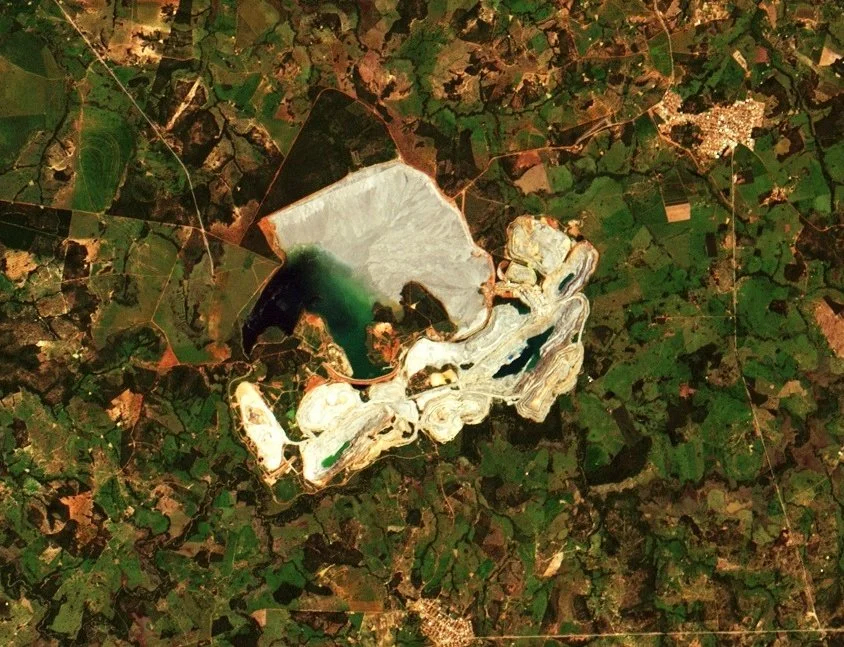
Chapada Mine, Goiás. Source: Wikimedia Commons. This file is licensed under the Creative Commons Attribution-Share Alike 2.0 Generic license.
Indigenous group in Brazil takes TikTok to court over planned data center
By Laís Martins
Martins’ report for Rest of the World examines the case of a data center TikTok is planning to build in Anacé land in Brazil. While the Brazilian government has big plans to transform the country into a data center hub, the Anacé Indigenous community is resisting the use of their land. Brazil, and especially the state of Ceará, is an attractive prospect for tech companies, as 80% of their electrical grid is fed by renewables, allowing companies who build data centers there to reduce emissions.
The Anacé, like many indigenous communities in Brazil, have no formal title to their land, despite their presence there having been documented since the 1600s. They have not been consulted on any of the projects that have been approved by the state to build tech and power infrastructure on their territory. In 2013, there was an oil refinery that the community successfully resisted, and in 2023 a thermal power plant was stopped from being built. The data center TikTok is planning to build is a concern for the community, who believe the projected daily water consumption of 30,000 liters is too low of an estimate compared to similar projects. The community is also, crucially, asking to be consulted on any future endeavours. They claim the right of consultation under an International Labour Organization Convention, of which Brazil is a co-signatory. Cacique Roberto Ytaysaba Anacé, a leader of the community, said: “They are putting it right next to the river” on Indigenous territory that holds spiritual and ceremonial significance for the community.
The AI industry is powered by data centers in polluted Californian communities
By Cecilia Marrinan
In an analysis for Tech Policy, Cecilia Marrinan of the Kapor Foundation focuses on the location of data centers and extracts insights from their geography. Their findings show us how data centers are clustered in highly polluted zones, with “nearly one-third of all operational and planned California data centers [...] located in the top 10% of areas most polluted by diesel particulates.” These pre-existing pollution levels will be compounded by the presence of the data centers, whose backup generators are sources of fine particulate matter (PM2.5), sulfur dioxide (SO2), and nitrogen oxides (NOx). The analysis also makes the case that these compounding effects could generate a public health crisis in this region, and that the effects, in areas marked by environmental racism and gentrification, will mostly impact communities of colour.
San Antonio data centers guzzled 463 million gallons of water as area faced drought

San Antonio. Source: Unsplash.
by Stephanie Koithan
Last summer, while the authorities in San Antonio were enforcing Stage 3 watering rules following drought conditions, The San Antonio Current reported that the 2 data centers in the area used the equivalent of tens of thousands of households worth of water. The drought comes after 5 years of inadequate rainfall, posing households under stress. Authorities are introducing fines for households that use more water than their allotted amount. However, the data centers operated by Microsoft and the Army Corps are not subjected to the same rules. “These centers are showing up in places that are very water-stressed,” Margaret Cook, a water policy analyst at the Houston Advanced Research Center (HARC), told Techie + Gamers. “There’s no requirement for them to have conversations with communities about how much water they’ll use.”
Big Tech data centers compound decades of environmental racism in the South
.jpg)
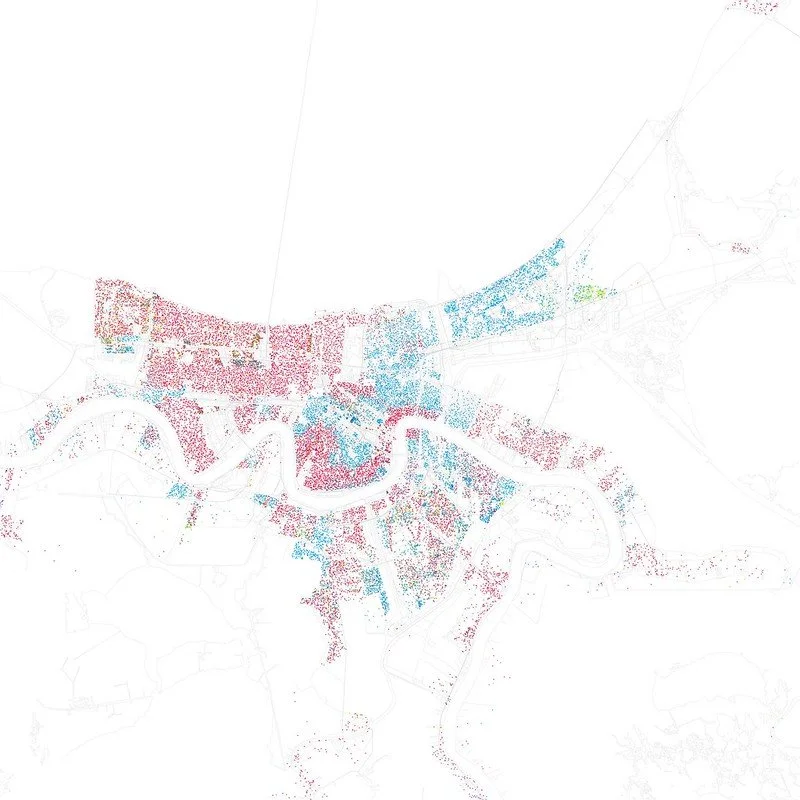
"Race and ethnicity: New Orleans" by Eric Fischer is licensed under CC BY-SA 2.0.
By Jai Dulani
In this article for Truthout, Jai Dulani analyses different reports connecting data centers with pollution, and traces the throughline: in the South of the United States, polluting data centers are often built in black neighbourhoods. Memphis, Tennessee, is home to xAI’s Colossus, while Meta has built its largest data center in Richland Parish, Louisiana. In Jackson County, Mississippi, coal plant Victor J. Daniel was destined to be decommissioned due to the detrimental health impacts of coal, as well as its environmental impacts. Now, it has received a special extension on its contract, to supply energy for a new data center. There is little public scrutiny on these developments: residents report that the town halls favour speakers that benefit from the data centers. Key information has been concealed, including water and energy consumption, and company names. Moreover, the job creation promised to these communities fails to materialise: few permanent jobs are made available for each center. Louisiana, Mississippi, Alabama, Georgia, Tennessee, and South Carolina have major tax exemptions for data center companies. Georgia is presumed to be waiving about $296 million in tax revenue from data centers this year. However, the South has a long history of resistance, which is alive and strong today. Dulani reports opposition to data centers in Bessemer, Alabama, Warrenton, Virginia, and Monroe County, Georgi, among others.
How your utility bills are subsidizing power-hungry AI
By Sasha Luccioni and Yacine Jernite
In this article for Tech Policy, Luccioni and Jernite trace the rising cost of electricity bills in the Eastern United States to the amount of electricity used by data centers in the same areas. The energy data centers use is very concentrated, and in the US, utility companies tend to fund large infrastructure projects by raising the cost for all their clients in the area. Moreover, prices rise based on demand, which increases when there is a concentration of data centers on the same energy grid. Luccioni and Jernite offer efficiency solutions: running models with fewer parameters achieves a similar effect using less energy. However, there isn’t much of a market incentive for AI companies to prioritise efficiency over the reputational risk of a slightly less powerful model. Ohio and Georgia are now legislating to make data centers, and not consumers, pay for the expanded infrastructure. The more systemic solution would be to shift our use of AI to systems based on specific demands, to solve problems more efficiently.
'A million calls an hour': Israel relying on Microsoft cloud for expansive surveillance of Palestinians
By Harry Davies and Yuval Abraham
In an investigation for the Guardian, Harry Davies and Yuval Abraham have traced the involvement of Microsoft in the Israeli surveillance apparatus that aids their strikes on the Palestinian population.
In 2021, Microsoft’s chief executive, Satya Nadella, met with Yossi Sariel, the commander of Israel’s military surveillance agency, Unit 8200. Microsoft agreed to store top secret intelligence material in a segregated area within Microsoft’s Azure cloud platform. The Guardian, together with +972 Magazine and Local Call, revealed that the data stored there was an archive of phone call data, belonging to Palestinians. The platform allowed Israeli intelligence to play back the phone calls, collecting immense amounts of granular data on the everyday lives of Palestinian people. Sources from within Unit 8200 revealed that this storage capacity would not be possible without Azure. According to Microsoft, they insisted their systems must not be used to identify targets for lethal strikes; however, Unit 8200 sources say that the data was used to identify bombing targets in Gaza. Microsoft’s review of the relationship with Israel “found no evidence to date” that Azure or its AI products were “used to target or harm people” in the territory.
Sariel initiated the mass surveillance of Palestinian communications, and used AI to extract insights. In 2021 he had also published under a pen name the book The Human Machine Team, a book about AI which supported the migration of military and intelligence agencies to the cloud.
Being able to store phone calls for a month or longer allowed the intelligence unit to play back previous conversations from people who came under their scrutiny. Before that, conversations could only be intercepted after a person became of interest. “In the ensuing war in Gaza, the cloud-based system pioneered by Sariel has been put to frequent use alongside a series of AI-driven target recommendation tools also developed on his watch and debuted by the military in a campaign that has devastated civilian life and created a profound humanitarian crisis.” The Guardian reports.
Our Observations
Through the cases we have highlighted, we can trace planetary justice impacts across all stages of the AI supply chain. From the lithium and gold extracted in Serbia and Brazil respectively, to data centers in Brazil and the US, to model deployment in Palestine, power imbalances are present every step of the way. However, resistance and public participation are also present in every instance. While Serbians are protesting against the environmental consequences of lithium extraction in Jadar and the corruption they suspect is present at the governmental level, the Anacé indigenous community in Brazil is standing up against the prospect of a data center being built in their territory, invoking international law in their favour. Communities in Alabama, Virginia, and Georgia are driving data centers away from their territory.
Through community organising, solidarity, and political resistance, communities will hopefully be able to negotiate a more just future for the planet. As we are still at the infancy of large-scale AI development, we are in the position of being able to affect its development while it’s still ongoing, insisting that our human and more-than-human communities deserve justice and a healthy planet on which to thrive.
We want to emphasise that the Observatory is a collective repository, and that we are always looking for submissions of case studies. This is a community-led, adaptive data collection effort. If you come across case studies similar to these, please submit them here!