
Introducing Our New Series: Mineral Extraction for AI
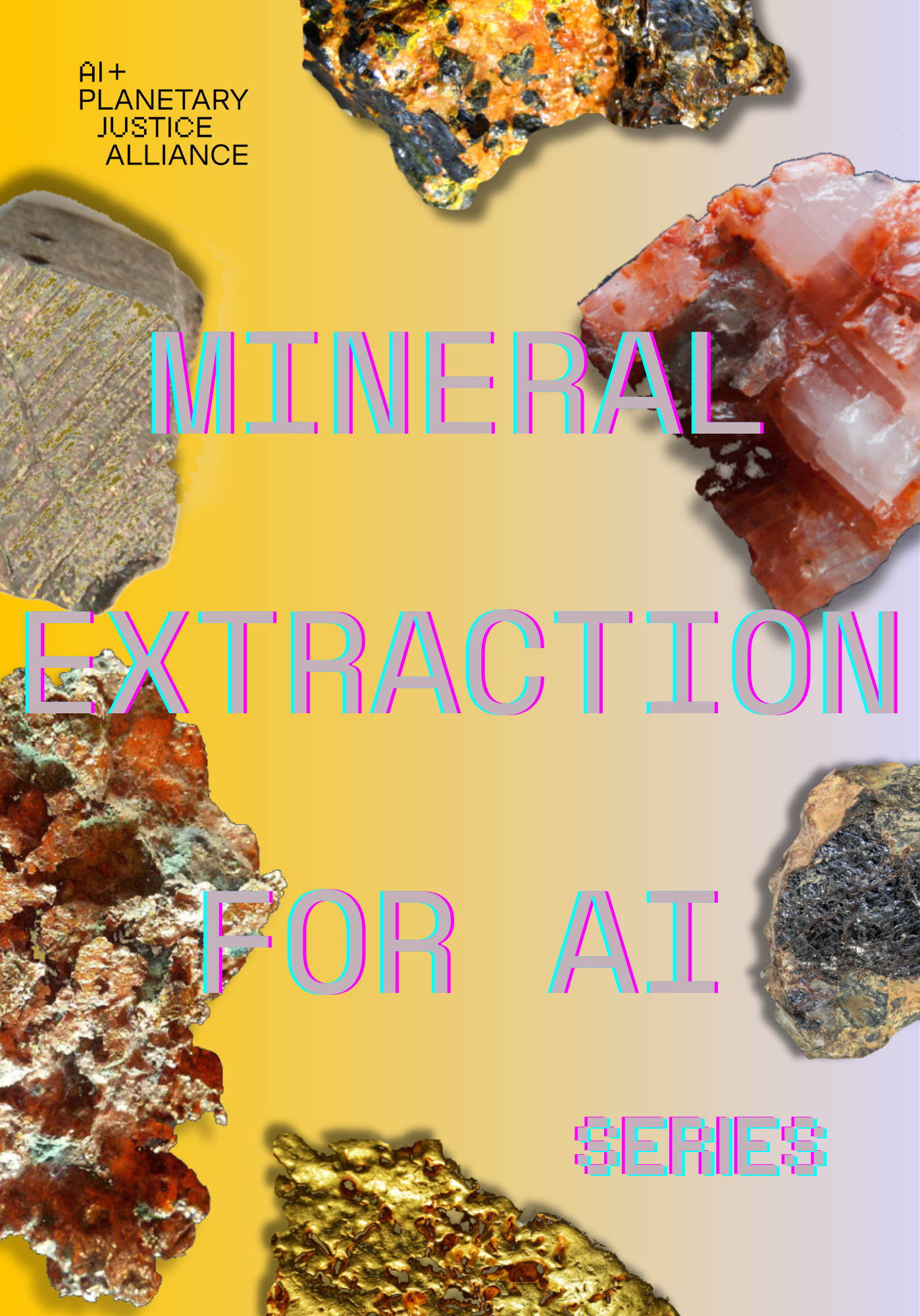
As part of our project Below the Algorithm, the Mineral Extraction for AI series examines the often-overlooked extractive foundations of AI by focusing on the planetary justice implications of mining raw materials for AI hardware and infrastructure, such as copper, cobalt, silicon, and rare earth elements. The first part of the series focuses on copper, and looks at Zambia as a case study (stay tuned to learn more about that!). In this research diary, I introduce the series as a whole and position it within our existing work. Each part of the series will consist of a research report, as well as a zine visualization, building on the Raw Materials for AI zine. This dual typology of outputs will allow us to reach different audiences, contexts, and needs.
Why Look at Mining for AI?
AI hardware and infrastructure require vast amounts of raw materials (see the Introduction to the Below the Algorithm post). For instance, a study on Microsoft’s $500 million Chicago data center found it used a total of 2,177 tonnes of copper in its construction, and AI is predicted to increase copper demand 50% by 2040.
Unlike other electronics or the Electric Vehicle (EV) sector, which require gradual supplies of raw materials to meet consumer needs, the rapid expansion of AI data centers requires a massive amount upfront for hardware, construction, and infrastructure connections, such as ensuring aluminum, copper, and steel power lines reach the electricity-hungry data centers. AI scaling is increasing demand for raw materials and intensifying and creating new mining operations.
Big AI companies often distance themselves from the environmental and social impact of mining and refining raw materials. In this series, our aim is to foreground these mining operations as a critical aspect of AI value chains and assess some of the planetary justice implications of mining these minerals.
What Will The Series Cover?
Each part of the series will highlight one of the 11 minerals identified in the Raw Materials for AI zine and be grounded in a case study of a mine or extraction location. In each case study, we use AIPJ’s AI Supply Chain Impact Framework to assess the planetary justice impacts of mining in that case and identify gaps in data and information for future research.
The mineral and mining case studies are not intended to be a definitive or exhaustive list of the planetary justice implications of mining for AI; rather, they are intended to produce systematized knowledge and raise awareness around the extractive foundations of AI. The outputs of this series serve as a record of what can be highlighted or estimated now and as a resource to encourage deeper engagements at the intersection of AI and planetary justice.
This project aims to start with the following research questions:
What are the main mining sites that supply critical materials for AI development?
How can we assess the planetary justice implications of these sites, and where are the informational gaps?
Who are the key stakeholders involved, and how can we build on their ongoing work?
How much responsibility can be attributed to AI-driven demand for each site’s impact?
Research Process & Initial Challenges
Mapping out different mining sites from tin mines in Indonesia to cobalt mines in the Democratic Republic of the Congo (DRC) is a process that underscores the interconnected and global nature of the AI stack. While AI’s technical innovation can emerge from any nation, minerals, especially those critical to AI hardware, are geographically constrained by geological purity and availability. Tracking these mineral supplies through the AI supply chain is complex, messy, and often lacks clear data trails that lead straight from the mine to the hardware company, to the data center, and to the AI company. For this research diary, I highlight some of the initial questions and friction points for this project:
1. How should we select mining sites for each case study?
In foregrounding planetary justice as the focal point for our analysis, this series aims to highlight mining case studies for the 11 materials in the Raw Materials for AI Zine list based on a series of selection criteria:
Material Grade & Purity
Only certain purity or grade of materials is suitable for manufacturing AI hardware like semiconductors. Therefore, when choosing a mining case, it is important to consider the corresponding grade or purity. For instance, silicon is one of the world’s most abundant resources, however, manufacturing silicon wafers for semiconductors requires extremely high-grade materials which is only found in places like Spruce Pine, North Carolina, which supplies 70-90% of the world’s high-purity quartz.
Planetary Justice Implications & Existing Case Studies
Many emerging mining sites, responding to rising material demand from the AI and green energy industries, are worth noting, but tracking ongoing planetary justice impacts is more difficult because they are so new. Mining sites with existing planetary justice case studies and activism linked to them are valuable starting points for building case studies. While there may be gaps in official information published by companies or in data availability on energy use or pollution levels, drawing on existing research and stakeholder work is a helpful way to build our case studies.
Field Work Opportunities or Stakeholder Connections
We are also excited to cultivate connections and collaborations with partners. Case selection is therefore sometimes influenced by our network, fieldwork opportunities, and language limitations. For instance, we have an exciting opportunity to collaborate with stakeholders in Zambia about mining in the Copperbelt Region, which will inform our case study on copper mining.
2. How should we tackle gaps or opacity in supply chain data?
Finding data on dimensions such as water use or pollution from mining operations, labor conditions, or even the next destination of raw materials after extraction is extremely difficult. Figuring out how to connect what little existing data there is with other nodes of the supply chain, such as refiners, manufacturers, chip designers, data centers, and AI SaaS companies, is even more difficult. Supply chain data opacity, especially in fabless companies, is a challenge I wrestled with in my past research projects on electronic waste flows and conflict mineral reports in NVIDIA’s supply chain. Through those research experiences, I learned to get creative about finding data trails and recognize even available data as sources of strategic corporate narrative building.
This project also draws on AIPJ’s AI Supply Chain Impact Framework, especially the sections on assessing the Planetary Justice dimensions of material extraction for AI hardware and infrastructure, by examining the land, water, energy, and labor implications of mining for each case study. This tool helps highlight what we do know and what we do not (yet) know about each case identified for this series.
We are not aiming for a perfectly cohesive or comprehensive data analysis; rather, we put different qualitative and quantitative sources and strategies in conversation to illustrate key planetary justice implications of mineral extraction for AI supply chains. Not every case study or site has the same data availability or even the same planetary justice dimensions; we are excited to collaborate with researchers and activists already working in these spaces to highlight future research directions. Interviews and site-specific fieldwork will help us fill some of these gaps.
3. How can we build effective stakeholder and community relationships throughout the research process?
Since we’re still at an early stage with the series, we hope to have another research diary reflecting on these collaborations soon. As we begin, we hope to build stakeholder relationships and projects based on learning and reciprocity. By connecting the strong legacy of mining labor and environmental justice activism to the tech infrastructure industry and the growing AI sector, we hope to build on existing efforts and join forces to foster awareness and develop locally-grounded policy alternatives.
Project Impact
Through the Mineral Extraction for AI Series, we hope to expose planetary justice impacts of mining raw materials for AI. By exploring the planetary justice dimensions of raw material extraction we enable transparency and accountability around raw materials for AI and build global networks of stakeholders invested in building transparency and accountability around raw material for AI.
If you have any suggestions for this series or leads for this research, feel free to email Bella at bella@aiplanetaryjustice.com.