
The AI Wave: Water implications in the age of AI
Artificial intelligence (AI) models such as large language models (LLMs), chatbots, and self-driving vehicles have become an integral part of our everyday lives and work. In fact, far too frequently, it is becoming difficult to operate without AI - or, remember a time without it. In enjoying its benefits, however, we often forget to account for its externalities and planetary justice consequences.
In our other projects at AIPJ, we analyze and expose AI’s material dependencies, through case studies on the planetary justice impacts of mining sites and data centers. In this project, we narrow our scope to focus on one sector of planetary justice: water. As the world simultaneously grapples with water scarcity and growing AI ubiquity, we raise an important question: what is the role of water in AI throughout the supply chain, and how is it governed? To answer this, we must first understand how much water is being consumed and/or polluted as a result of artificial intelligence. We already know that data centers are massive consumers of water - with a mid-sized AI data center requiring 5 million gallons of water each day - as much water as a city of 50,000 people. However, there still isn’t enough literature available on water consumption across the remaining stages of the AI supply chain. In this project, thus, we look into water risk and redistribution through consumption and pollution across the AI supply chain, document who suffers in this process, and attempt to ascertain who must be held accountable. As 25% of the population already experiences water stress for at least one month a year, our hope with this project is to garner the much-needed attention on the hefty water demands of AI, inform a data-driven conversation of its impacts, and encourage diverse stakeholders to hold the relevant parties accountable against the proliferation of AI.

The structure of our project follows the 6 identified research areas across the AI supply chain life cycle. In our first publication, we focus on the first two, namely, raw materials extraction and materials manufacturing.
AI hardware is built on critical raw materials such as Copper, Cobalt, Silicon, Lithium, and Rare Earth Minerals (REE). These minerals are extracted from across a number of countries, including China, Chile, the Democratic Republic of Congo (DRC), and Argentina, and go through a tedious process from mining to manufacturing.
Mining, as we know, is a resource-intensive industry. Not only does it rely heavily on water for a variety of uses across the pipeline, but can also lead to the contamination of nearby ground and surface water bodies as wastewater from mines are often inadequately handled and released into them. Examples of this are already being documented across the world: in Tibet’s Liqi River, toxic chemicals such as hydrochloric acid are released into the water body as lithium is processed into a more usable form. In Chile’s Salar de Atacama, 65% of the region's water supply is directed towards mining for lithium.
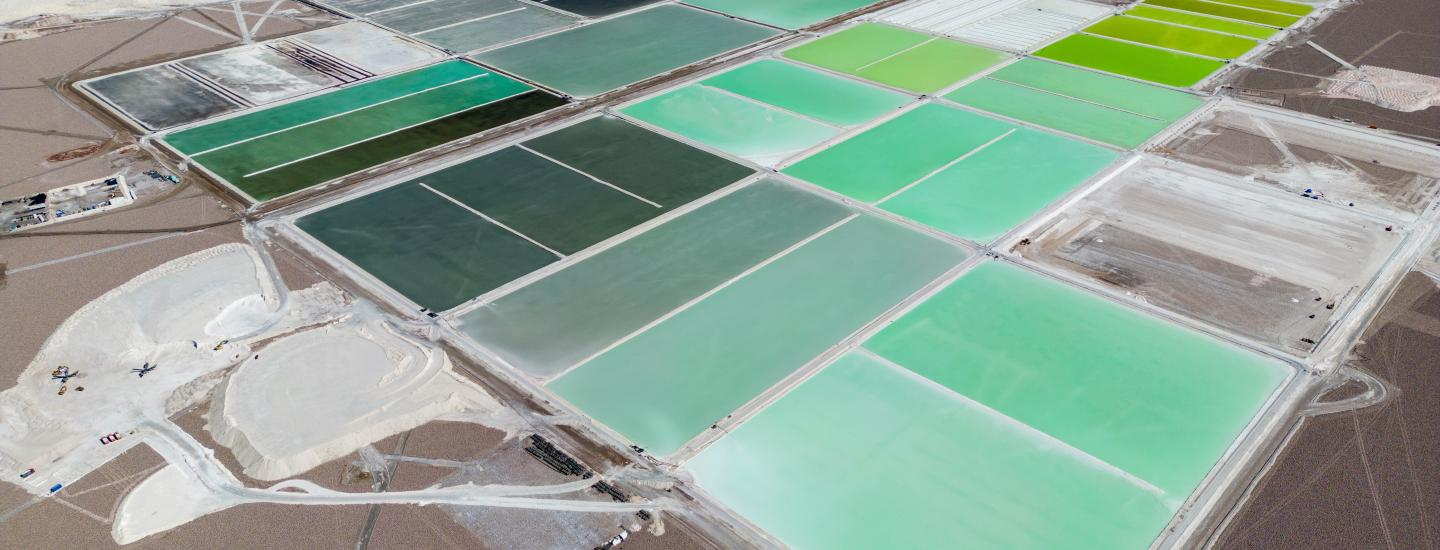
Lithium mining in Chile’s Salar de Atacama region where lithium is mined through pumping it from the earth and storing it in shallow ponds for 12-18 months until the water fully evaporates, leaving concentrated brine heavy in lithium behind.
Source: World Resources Institute, 2024.
The International Energy Agency (IEA) in 2025 estimated the copper and silicon demands for data centers alone could rise up to 512,000 tonnes and 75,000 tonnes by 2030. Although these figures seem conservative in absolute terms, their impact on neighbouring societies and on the environment are harshly felt, as seen above. It has also been documented that 16% of the critical mines - many of which overlap with AI hardware - are located in water stressed regions, making it even more vital that we remain cognizant and proactive about how and where water resources are being distributed and utilized.
Our attempt at doing this is to explore how, how much and what type of water is consumed and polluted through the pipeline. We follow the 11 most critical raw materials used in AI hardware from extraction to manufacturing, mapping both their geographies and water demand. Our goal is not to attribute a numerical value to the impact of AI on water availability and quality, but to consolidate and contextualise fragmented evidence on water use, pollution, and governance. Ultimately, we would like to develop a comprehensive report and interactive map to support advocacy by any individual or organisation for access to clean water, hold their local governing bodies accountable, organise resistance, or even use as foundational information in further investigating the hidden planetary justice costs of AI.
We follow a multimodal methods approach. To begin with, we look at mining reports, environmental clearance reports, water quality datasets, remote-sensing data, climate datasets, and proxy indicators such as water stress indices, pollution incidents, and discharge permits. This project aims at being a knowledge product on the impacts of AI on water, but also a growing repository to inform further and specific research. As such, we hope to supplement our efforts in data collection and analysis with stakeholder conversations across the board - policymakers, journalists, CSOs, NGOs - on their experiences and perspectives.
This effort isn’t without its challenges: certain limitations we anticipate are:
Attribution challenges: We recognise that minerals used in AI hardware are also extracted for other uses, and thus cannot determine an exact quantity of water consumed. To tackle this, we calculate a proportional attribution for water consumed during the extraction process. First, through estimating how much water is consumed per unit of each mineral mined and multiplying it by the total amount of each mineral used in select AI hardware. Second, we want to map the different entities responsible for the mine in relation to regulations and enforcements for water consumption.
Methodological developments: New methods and technologies of material extraction and manufacturing are constantly being developed making it possible that mining companies are already attempting to employ more water-efficient technologies. In this study, however, we focus our attention on the most common global mining methods.
Availability of data: Availability of mining data is sparse as it isn’t frequently updated to the public domain. One way we plan to work around this is to engage with domain experts from industry and academia to supplement our secondary research.
Impact of geopolitics: Influence of geopolitics on the location of mining sites. There has been a recent increase in demand for critical materials including Rare Earth Elements (REEs), Cobalt, and Lithium amongst others as global interest in AI technologies, green tech, and defence technologies are increasing. This has led to a shift in global attention (particularly by countries with production capacity) to countries with large reserves of these minerals. A sudden increase in geopolitical importance of these minerals has also resulted in mining companies or countries either bypassing environmental regulations in countries with weaker enforcement, or strengthening their mining practices to adhere to the sustainable development goals.
What’s next: We will keep updating our research diaries with bits of information, our learnings, methodologies, and way forward. If you work in relevant domains, or are simply interested in this work, we would love to hear from you. You can reach out to us at esha@aiplanetaryjustice.com.